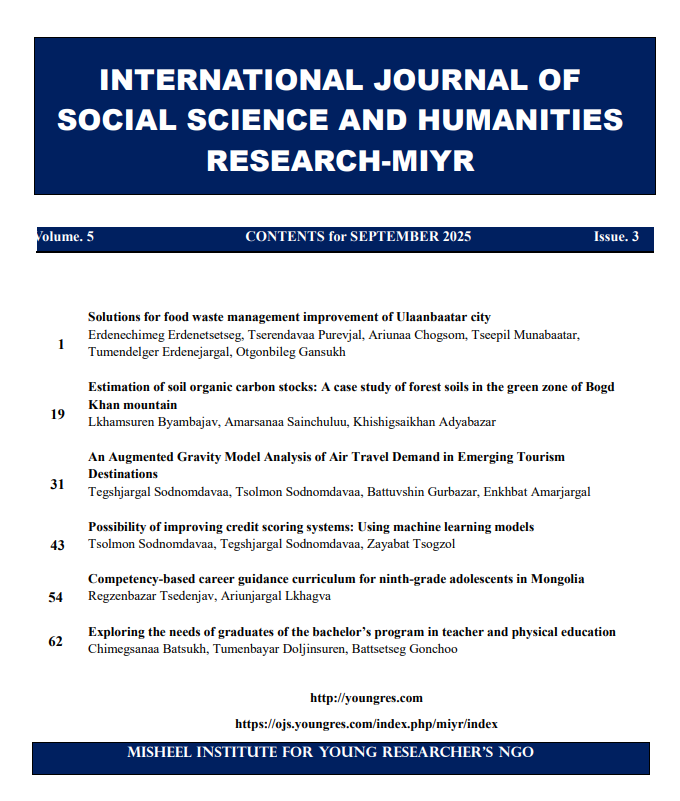
Solutions for food waste management improvement of Ulaanbaatar city
DOI:
https://doi.org/10.53468/ijsshr-miyr.v5i3.9Keywords:
Waste management, Solid waste, Biodegradable waste, RecyclingAbstract
Municipal solid waste has become one of the major challenges facing Mongolia over the years. According to the report published by the Ministry of Construction and Urban Development (MCUD) in 2024, approximately 2.9 million tons of solid waste are generated annually in Mongolia, out of which approximately 1.2 million tons are in Ulaanbaatar. However, only 17-20 percent was recycled while the rest was dumped directly into the landfills polluting the soil and adversely affecting livestock, animals and the health of the people. In Ulaanbaatar, food waste accounts for 41% of the total household waste in summer and 36.2% in winter. Statistical data released by the Mongolian National Statistical Office show that as of 2023, over 1.7 million people which account for over half of the Mongolian population reside in Ulaanbaatar, the capital city of Mongolia. Due to the growing population, the amount of waste generated in Ulaanbaatar has increased sevenfold in the last 3 years. If solid waste generated from variable sources are mixed with food waste, it can be difficult to recycle the mixed waste. Food waste sorting at source brings numerous benefits such as putting it into economic circulation through recycling, mitigating the adverse effects on the environment, and producing organic products. Therefore, in this study, we aim to raise awareness and understanding of waste, biodegradable waste, and the ways of sorting out and improving food waste. Moreover, we aim to publish a guidebook on Food Waste Management Improvement using the data gathered as a result of this study.
References
Kaza, S., Yao, L.C., Bhada-Tata, P. and Van Woerden, F. (2018), What a Waste 2.0: A Global Snapshot of Solid Waste Management to 2050. Urban Development. World Bank, Washington DC. doi.org/10.1596/978-1-4648-1329-0
Mongolia National Waste Management Improvement Strategy and Action Plan 2017-2030.
Sarangoo. I, 2. (2020). Landfilling and incineration are not eco-friendly methods for humans and the environment.
Erdene. B. (2018). Waste management.
European Environment Agency (2020).
Bio waste in management Europe-turning challenges into opportunities, p. 2.-2. (2018).
Field experiences at the Fukushima biomass power plant, 2020)
Pham, T. P. (2014). Food waste-to-energy conversion technologies-current status and future directions.
Downloads
Published
How to Cite
Issue
Section
Categories
License
Copyright (c) 2025 Erdenechimeg Erdenetsetseg, Tserendavaa Purevjal, Ariunaa Chogsom, Tseepil Munabaatar, Tumendelger Erdenejargal, Otgonbileg Gansukh

This work is licensed under a Creative Commons Attribution 4.0 International License.


