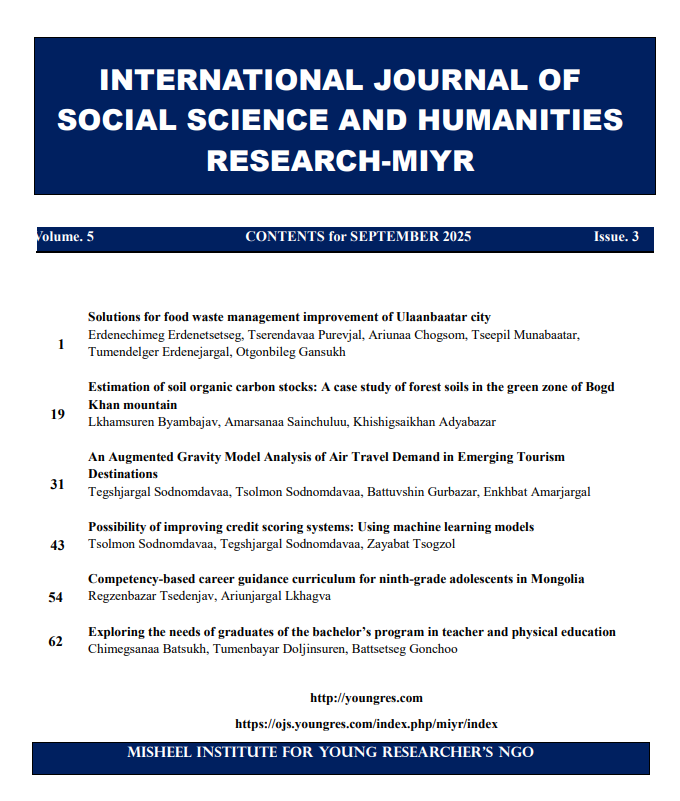
Exploring the needs of graduates of the bachelor’s program in teacher and physical education
DOI:
https://doi.org/10.53468/ijsshr-miyr.v5i3.8Keywords:
Stakeholders, Physical education teacher, Needs assessment, CurriculumAbstract
The significance of this study lies in its contribution to curriculum enhancement through the inclusion of graduates’ perspectives and needs. By reflecting their feedback, the study supports the development of professional competencies and career success among graduates, thereby promoting the overall quality of education and informing future policy directions. The primary aim of this research is to identify the needs and expectations of graduates from the “Teacher and Physical Education” bachelor program and to propose recommendations for curriculum improvement based on the findings. The study was conducted by aligning the curriculum with the indicators set by the Mongolian Higher Education Accreditation Council (MIUZ), the satisfaction survey indicators approved by the Rector’s Order No. A/321 of the Mongolian National University of Education (MNUE) dated November 22, 2023, and the international teacher education standards developed by SHAPE America and EUPEA for physical education programs. A four-phase research design was employed to examine the graduates’ needs and expectations. In the first phase, a total of 84 graduates from the academic years 2020–2024 participated, of whom 56% were male and 44% were female. The internal consistency reliability of 79 variables across nine questionnaire items was tested using Cronbach’s alpha, yielding a value of 0.971, indicating excellent reliability. Data analysis was conducted using SPSS version 26. Both quantitative and qualitative approaches were integrated through a mixed-methods research design. Descriptive statistics, t-tests, ANOVA, correlation, internal consistency, factor analysis, and cluster analysis were applied to examine the collected data. The findings indicate that the “Teacher and Physical Education” bachelor program effectively equips graduates with competencies required by the labor market. Furthermore, graduates’ knowledge, skills, and attitudes demonstrated strong correlations with academic knowledge formation (r = .667) and curriculum alignment (r = .544). These results confirm that the bachelor program in physical education education has a comprehensive and positive impact on graduates’ knowledge, skills, and professional development, establishing a statistically significant relationship between educational quality and student growth.
References
Education Evaluation Center. (2022). Survey on the readiness of Mongolian learners for online learning.
UNESCO. (2019). Report on the process of developing, implementing, and evaluating the curriculum of general education schools in Mongolia: An overview of Mongolia’s education policy analysis. Ulaanbaatar.
Government of Mongolia. (2024, March 6). Resolution of the Government of Mongolia. Ulaanbaatar.
Minister of Education and Science of Mongolia. (2024, March 20). Annex to Order No. A/147.
Ministry of Education, Culture, Science and Sports. (2019). Basic education information report of Mongolia. Ulaanbaatar.
Nagy, G. D., & Jancsák, C. (2022). The future of human resource management education and training in tertiary academic institutions. Social Science and Humanities Journal, 6(11), 2973–2980.
Gaela, J. C., & Ofrin, D. (2024, August). MAPEH teachers’ academic optimism, pedagogical content knowledge, and physical literacy. Social Science and Humanities Journal, 8(8), 4555–4566. doi.org/10.18535/sshj.v8i08.1265
Matira, E. T., & Ofrin, D. D. (2024, September). Competence and performance of physical education teachers in selected secondary schools of Calamba City. Social Science and Humanities Journal, 8(9), 4819–4831. doi.org/10.18535/sshj.v8i09.1302
Dagdag, B. A., & Guillermo, R. V. (2024, June). Teachers' technological, pedagogical, and content knowledge and students' performance in the ESL classroom. Social Science and Humanities Journal, 8(6), 4091–4023. doi.org/10.18535/sshj.v8i06.1168
Abubakira, H., & Alshaboul, Y. (2023). Unravelling EFL teachers' mastery of TPACK: Technological, pedagogical, and content knowledge in writing classes. Heliyon, 9(6), e045565. linkinghub.elsevier.com/retrieve/pii/S2405844023045565
Adipat, S. (2021). Developing technological pedagogical content knowledge (TPACK) through technology-enhanced content and language-integrated learning (T-CLIL) instruction. Education and Information Technologies, 26(5), 6461–6477. doi.org/10.1007/s10639-021-10648-3
SHAPE America. (2017). National standards and guidelines for physical education teacher education.
European Physical Education Association (EUPEA). (n.d.). Projects.
University of Florida Libraries. (n.d.). University of Florida Libraries.
The University of Queensland. (n.d.). The University of Queensland.
German Sport University Cologne. (n.d.). German Sport University Cologne.
University of Tsukuba. (n.d.). University of Tsukuba.
Downloads
Published
How to Cite
Issue
Section
Categories
License
Copyright (c) 2025 Chimegsanaa Batsukh, Tumenbayar Doljinsuren, Battsetseg Gonchoo

This work is licensed under a Creative Commons Attribution 4.0 International License.


