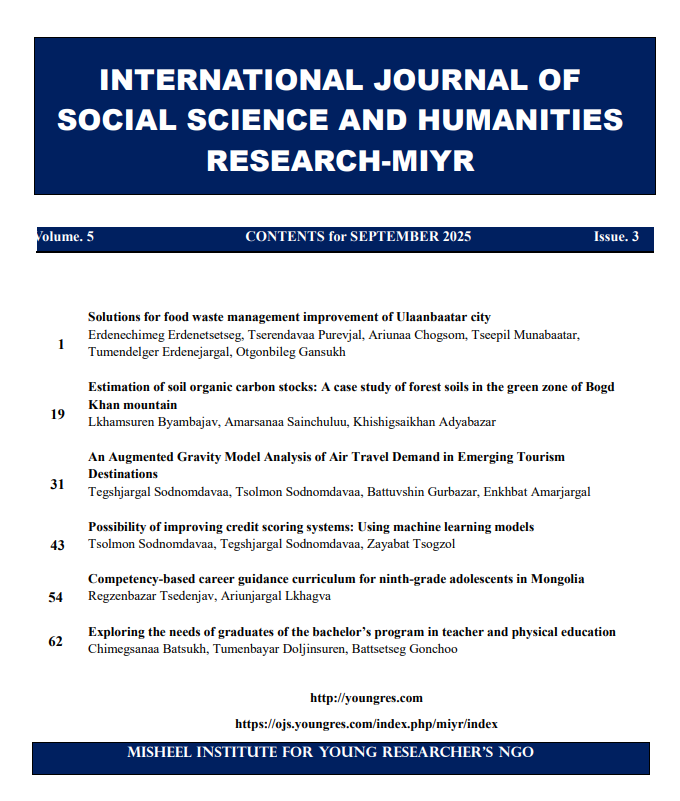
Estimation of soil organic carbon stocks: A case study of forest soils in the green zone of Bogd Khan mountain
DOI:
https://doi.org/10.53468/ijsshr-miyr.v5i3.6Keywords:
Forest soil, Soil organic carbon (SOC), Soil organic carbon stock (SOC stock), Soil degradation, Green belt, Bogd Khan MountainAbstract
This study examined soils in the 25 -hectare forest area of the green belt in the Ar and Uvur Zaisan valleys of Bogd Khan Mountain. Soil profiles were sampled, morphological descriptions were conducted, and agrochemical properties were determined, including the content and stocks of soil organic carbon (SOC). The forest soils of the study area are classified as mountain mollic umbrisols. In urban green spaces, intensive human activities—such as high population density, increased vehicular and machinery traffic, and inappropriate land use planning—have led to soil and surface layer degradation, compaction, and erosion, as well as a reduction in plant species diversity, resulting in accelerated land degradation. Therefore, we urgently require effective measures to protect the green belt forests and implement optimal land-use management. The aim of this study was to determine SOC content and stocks in the green belt forests of Bogd Khan Mountain, specifically in the Ar and Uvur Zaisan valleys of Ulaanbaatar. To achieve this, we assessed soil fertility indicators and estimated SOC stocks within the study plots. Results from the Uvur Zaisan valley showed that soils in the 0–30 cm layer were moderately acidic (pH 5.20–5.80), with humus content of 8.1–14.1%, SOC of 4.7–8.2%, cation exchange capacity of 10.50–70.00 mg, phosphorus content of 0.77–1.49 mg, and potassium content of 32.00–60.00 mg. In comparison, soils from the Ar Zaisan valley were slightly acidic (pH 6.08–6.70), with humus content of 7.0–12.5%, SOC of 4.0–7.2%, cation exchange capacity of 11.0–60.7 mg, phosphorus content of 0.77–1.00 mg, and potassium content of 37.50–81.00 mg. SOC stock assessments revealed 148.67 t ha⁻¹ in the 0–30 cm soil layer of Uvur Zaisan forests and 137.29 t ha⁻¹ in Ar Zaisan forests.
References
Jobbágy, E. G., & Jackson, B. R. (2020). The vertical distribution of soil organic carbon and its relation to climate and vegetation. Open Journal of Ecology, 423–436. doi.org/10.2307/2641104
Jenkinson, D. S., Adams, D. E., & Wild, A. (1991). Model estimates of CO₂ emissions from soil in response to global warming. Nature, 351(6324), 304–306. doi.org/10.1038/351304a0
Schlesinger, W. H., & Andrews, J. A. (2000). Soil respiration and the global carbon cycle. Biogeochemistry, 48, 7–20. doi.org/10.1023/A:1006247623877
Lal, R. (2010). Managing soils and ecosystems for mitigating anthropogenic carbon emissions and advancing global food security. BioScience, 60(9), 708–721. doi.org/10.1525/bio.2010.60.9.8
Pierre, F., Malte, M., Vivek, K. A., Chris, D. J, Alessandro, A., Spencer K. L., & Reto K. (2014). Uncertainties in CMIP5 climate projections due to carbon cycle feedbacks. Journal of Climate, 27(2), 511–526. doi.org/10.1175/JCLI-D-12-00579.1
Food and Agriculture Organization & Intergovernmental Technical Panel on Soils (2020). Global Soil Organic Carbon Map V1.5.
Batkhishig, O. (2021). Mongolian soil organic carbon stocks. Mongolian Journal of Soil Science, 6, 6–14.
GZBGZZG. (2018). Urban and settlement green space survey. Ulaanbaatar.
Ganzorig, O., Elbegzayaa, G., & Byambaa, G. (2019). Soil organic carbon in green spaces of Ulaanbaatar. Mongolian Journal of Soil Science, 4, 27–35.
Odgerel, B., & Buyanbaatar, A. (2018). Soil science. Ulaanbaatar.
Avadorj, D., & Ganga, A. (2019). Soil science. Ulaanbaatar.
Brady, N. C., & Weil, R. R. (2002). The nature and properties of soils (13th ed., p. 960). doi.org/10.1023/A:1016012810895
Lkhamssüren, B. (2023). Common terms and definitions in soil science. Ulaanbaatar.
Havlin, J. L., Beaton, J. D., Tisdale, S. L., & Nelson, W. L. (1999). Soil fertility and fertilizers: An introduction to nutrient management (6th ed., pp. 345–355).
Institute of Geography and Geoecology. (2019). Soil protection and soil organic carbon stocks. Ulaanbaatar.
Zoljargal, Kh., Ikhbayar, D., & Purevdorj, Ts. (2021). Determination of soil macro-fraction organic carbon. Mongolian Journal of Soil Science, 6, 78.
Caitlin, E. H. P., Benjamin, N. S., Corinna, W., Caitlin, O., Erik, P., Rachel, C. P., Cristina, C., Biao Zhu, Daniel B. Wiedemeier & Margaret S. T. (2018). Root litter decomposition slows with soil depth. Soil Biology and Biochemistry, 125, 103–114. doi.org/10.1016/j.soilbio.2018.07.021
Ciais, P., Sabine, C., Bala, G., Bopp, L., Brovkin, V., al., E., & House, J. I. (2014). Carbon and other biogeochemical cycles. In Climate change 2013: The physical science basis. Contribution of Working Group I to the Fifth Assessment Report of the IPCC (pp. 465–570). Cambridge University Press. doi.org/10.1017/CBO9781107415324.015
Scharlemann, J. P., Tanner, E. V., Hiederer, R., & Kapos, V. (2014). Global soil carbon: Understanding and managing the largest terrestrial carbon pool. Carbon Management, 5(1), 81–91. doi.org/10.4155/cmt.13.77
Byambaa, G., & Elbegzayaa, G. (2019). Changes in soil organic carbon over 50 years in north eastern Khangai region. Mongolian Journal of Soil Science, 4, 60–66.
Bolormaa, Ts. (2017). Issues in soil organic matter determination methods. Mongolian Journal of Soil Science, 2, 30–36.
Bolormaa, Ts. (2018). Grassland fires and changes in soil organic carbon. Mongolian Journal of Soil Science, 3, 34–42.
Delgertsetseg, R., Ganbat, D., & Uyanga, B. (2021). Urban green space soil survey results.
Batkhishig, O. (2018). Changes in organic matter of central Mongolian steppe soils after 90 years. Mongolian Journal of Soil Science, 3, 15–25.
Telmen, T., & Ikhbayar, D. (2019). Soil organic carbon stocks in mountain-steppe forest soils. Mongolian Journal of Soil Science, 4, 127–134.
Zolzayaa, M. (2020). Organic carbon content and stocks in high mountain and permafrost soils of Mongolia. Mongolian Journal of Soil Science, 5, 10–15.
Enkhtuya, B., Munkhtsetseg, T., & Oyuntsogt, G. (2020). Changes in organic carbon of cultivated dark brown soils over 50 years. Mongolian Journal of Soil Science, 5, 67–75.
Batkhishig, O. (2020). Organic carbon content, stocks, and regional differences in Gobi dark brown soils. Mongolian Journal of Soil Science, 5, 16–22.
Oyuntbat, P., & Odontungalag, D. (2020). Soil degradation and organic carbon loss in mining areas. Mongolian Journal of Soil Science, 5, 44–51.
Otgonsuren, B., Rosinger, C., Wang, L., & Godbold, D. L. (2020). Winter soils of Mongolian forests have viable ectomycorrhizas and soil enzymatic activity. Soil Biology and Biochemistry, 148, 107914. doi.org/10.1016/j.soilbio.2020.107914
Oyuntbat, P., & Elbegzayaa, G. (2021). SOC stocks in dry brown and light-brown steppe soils. Mongolian Journal of Soil Science, 46–55.
Byambaa, G., Elbegzayaa, G., & Zolzayaa, M. (2021). Estimating SOC using mass- and volume-based gravel content. Mongolian Journal of Soil Science, 6, 27–34.
Ganzorig, O. (2021). SOC stocks in brown and light brown soils of the Gobi. Mongolian Journal of Soil Science, 6, 95–109.
Batkhishig, O., Nyamsambuu, N., Dorjgotov, D., & Nyamdavaa, B. (2015). Terelj River Basin geosystem.
Batkhuyag, A., Bayrsaikhan, U., & Batbileg, A. (2023). Investigation on the variables influencing the flowering process of Siberian larch trees. International Journal of Social Science and Humanities Research (MIYR), 3(2). doi.org/10.53468/mifyr.2023.03.02.23
Bayarsaikhan, B., Saruul, S., Zolzaya, B., & Oyunchimeg, T. (2021). Ecological and economic evaluation of land use in Zaisan slope of the Bogd Khan Mountain. International Journal of Social Science and Humanities Research (MIYR), 1(1), 11–23. doi.org/10.53468/mifyr.2021.01.01.11
Byrne, K. A., et al. (2023). Soil organic carbon stocks in Irish afforested mineral soils: Variation with soil type to 100 cm depth. Geoderma Regional, 31, Article e00543. doi.org/10.1016/j.geodrs.2023.e00543
Downloads
Published
How to Cite
Issue
Section
Categories
License
Copyright (c) 2025 lkhamsuren Byambajav, Amarsanaa Sainchuluu, Khishigsaihan Adiyabazar

This work is licensed under a Creative Commons Attribution 4.0 International License.


