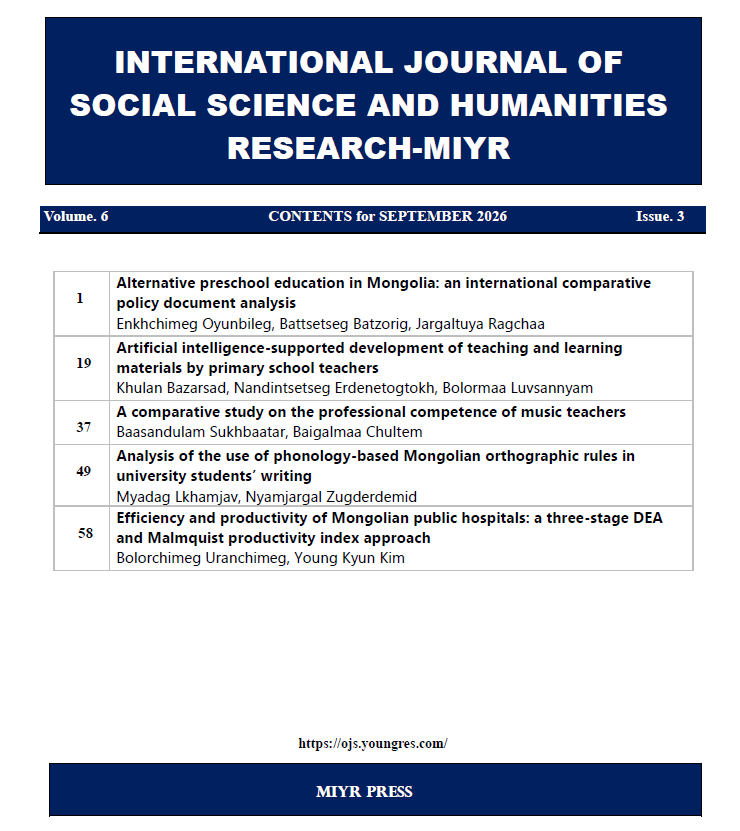
Artificial intelligence-supported development of teaching and learning materials by primary school teachers
DOI:
https://doi.org/10.53468/mifyr.2026.6.3.19Keywords:
Artificial intelligence; Primary education; Instructional materials; AI literacy; AI-TPACK; Teacher competenceAbstract
This qualitative international review examines how primary school teachers use artificial intelligence (AI) to develop teaching and learning materials. A structured search of Scopus and Google Scholar identified 191 records published between 2020 and 2026, of which 14 studies were included in the thematic synthesis. Five themes were analyzed: AI-supported material development, inclusive instruction, AI literacy and AI-TPACK, teacher verification, and institutional and ethical conditions. Findings indicate that AI facilitates material generation and adaptation, but effectiveness depends on teachers’ ability to verify accuracy and align outputs with curricula and learners’ needs. Key concerns include misinformation, privacy, copyright, bias, technological dependence, and limited institutional support. Based on the findings, a teacher-centered framework comprising three phases and 10 stages is proposed to guide responsible AI-supported instructional material development and inform future empirical validation.
References
[1] Sunaengsih, C., Komariah, A., Kurniady, D. A., & Salsabil, S. H. (2025). AI-based teaching materials for deep learning: An analysis of usage by elementary school teachers. International Journal of Educational Management and Innovation, 6(2), 184–201. https://doi.org/10.12928/ijemi.v6i2.12991
[2] Rachmadtullah, R., Tanod, M. J., Rasmitadila, R., Irawan, N., McNeilly, A., & Suharni, S. (2024). Elementary school teachers’ perspectives on utilizing artificial intelligence for developing learning media. Journal of Integrated Elementary Education, 4. https://doi.org/10.21580/jieed.v4i1.21994
[3] Tsogbadrakh, E., Munkhnasan, D., & Sumiya, U. (2025). Intellectual property regulations in school textbooks and curriculums. International Journal of Social Science and Humanities Research-MIYR, 5(4), 25–34. https://doi.org/10.53468/mifyr.2025.5.4.25
[4] Basaruddin, M., & Mustafa, H. R. (2025). Empowering AI for English materials analysis in Malaysian primary special education schools. AJELP: Asian Journal of English Language and Pedagogy, 13(1), 16–40. https://doi.org/10.37134/ajelp.vol13.1.2.2025
[5] Yim, I. H. Y., & Su, J. (2025). Artificial intelligence literacy education in primary schools: A review. International Journal of Technology and Design Education, 35, 2175–2204. https://doi.org/10.1007/s10798-025-09979-w
[6] Du, H., Sun, Y., Jiang, H., Atiquil Islam, S. Y. M., & Gu, X. (2024). Exploring the effects of AI literacy in teacher learning: An empirical study. Humanities and Social Sciences Communications. https://doi.org/10.1057/s41599-024-03101-6
[7] Mazı, A., & Yıldırım, O. (2025). Primary school teachers’ opinions on the use of artificial intelligence in educational practices. Social Sciences and Humanities Open, 11(1), 184–211. https://doi.org/10.1016/j.ssaho.2025.101576
[8] Mishra, P., & Koehler, M. J. (2006). Technological pedagogical content knowledge: A framework for teacher Knowledge. Teachers College Record, 108(6). https://doi.org/10.1111/j.1467-9620.2006.00684.x
[9] Celik, I. (2023). Towards Intelligent-TPACK: An empirical study on teachers’ professional knowledge to ethically integrate artificial intelligence (AI)-based tools into education. Computers in Human Behavior, 138. https://doi.org/10.1016/j.chb.2022.107468
[10] Li, M., & Manzari, E. (2025). AI utilization in primary mathematics education: A case study from a southwestern Chinese city. Education and Information Technologies, 30(9), 11717–11750. https://doi.org/10.1007/s10639-025-13315-z
[11] Polak, S., Schiavo, G, & Zancanaro, M. (2022). Teachers’ perspective on artificial intelligence education: An initial investigation. In CHI Conference on Human Factors in Computing Systems Extended Abstracts, 1–7. https://doi.org/10.1145/3491101.3519866
[12] Yumbul, E., & Sulak, S. E. (2024). Examining the views of primary school teachers on the use of artificial intelligence in education. Education Mind, 3(3), 303–317. https://doi.org/10.58583/EM.3.3.2
[13] Arksey, H., & Malley, L. O. (2005). Scoping studies: Towards a methodological framework. International Journal of Social Research Methodology, 8(1), 19–32.
[14] Levac, D., Colquhoun, H., & O’brien, K. K. (2010). Scoping studies: Advancing the methodology. Implementation Science, 5. https://doi.org/10.1186/1748-5908-5-69
[15] Jiang, C., Laknapichonchat, T., Rakthin, C., & Suryanti, S. (2026). The impact of AI on primary school teachers’ TPACK transformation challenges in the Chinese education context. International Journal of Learning, Teaching And Educational Research, 25(3), 100–115. https://doi.org/10.26803/ijlter.25.3.5
[16] Kosmas, P., Nisiforou, E. A., Kounnapi, E., Sophocleous, S., & Theophanous, G. (2025). Integrating artificial intelligence in literacy lessons for elementary classrooms: A co-design approach. Educational Technology Research and Development, 73, 2589–2615. https://doi.org/10.1007/s11423-025-10492-z
[17] Erol, M., & Erol, A. (2024). Use of artificial intelligence (AI) technologies in education according to primary school teachers: Opportunities and challenges. Sakarya University Journal of Education, 14(3), 426–446. https://doi.org/10.19126/suje.1446227
[18] Du, H., Sun, Y., Jiang, H., Atiquil Islam, S. Y. M., & Gu, X. (2024). Exploring the effects of AI literacy in teacher learning: An empirical study. Humanities and Social Sciences Communications. https://doi.org/10.1057/s41599-024-03101-6
[19] Hava, K., & Babayiğit, Ö. (2024). Exploring the relationship between teachers’ competencies in AI-TPACK and digital proficiency. Education and Information Technologies, 30, 3491–3508. https://doi.org/10.1007/s10639-024-12939
[20] Yue, M., Jong, M. S. Y., & Ng, D. (2024). Understanding K–12 teachers’ technological pedagogical content knowledge readiness and attitudes toward artificial intelligence education. Education and Information Technologies, 29, 19505–19536. https://doi.org/10.1007/s10639-024-12621-2
[21] Topkaya, Y., Dogan, Y., Batdi, V., & Aydin, S. (2025). Artificial intelligence applications in primary education: A quantitatively complemented mixed-meta-method study. Sustainability, 17(7). https://doi.org/10.3390/su17073015
[22] Yim, I. H. Y., & Wegerif, R. (2024). Teachers’ perceptions, attitudes, and acceptance of artificial intelligence (AI) educational learning tools: An exploratory study on AI literacy for young students. Future in Educational Research, 2(4), 318–345. https://doi.org/10.1002/fer3.65
Downloads
Published
How to Cite
Issue
Section
Categories
License
Copyright (c) 2026 Khulan Bazarsad, Nandintsetseg Erdenetogtokh, Bolormaa Luvsannyam

This work is licensed under a Creative Commons Attribution 4.0 International License.


