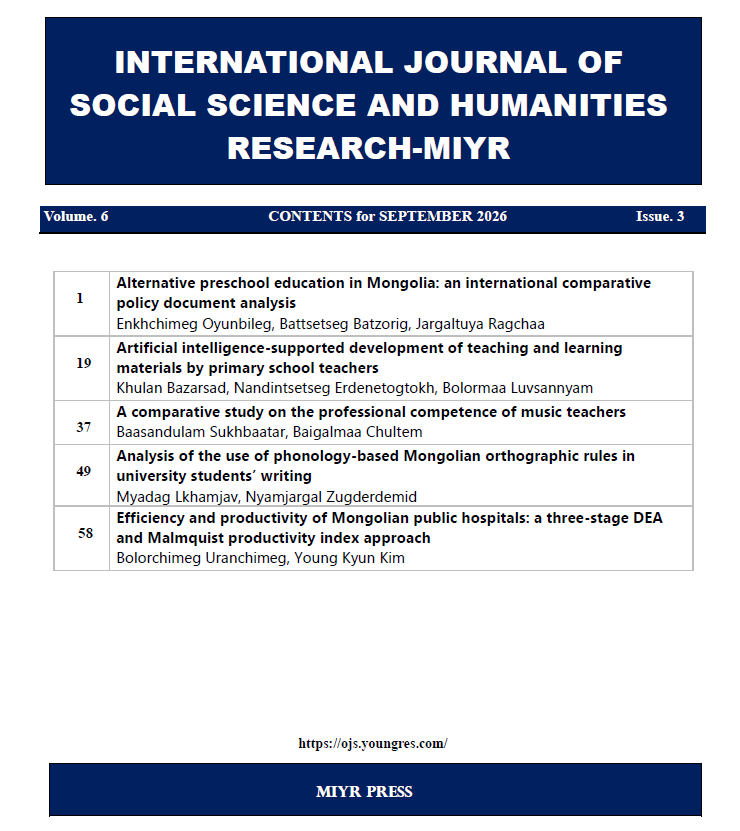
Alternative preschool education in Mongolia: an international comparative policy document analysis
DOI:
https://doi.org/10.53468/mifyr.2026.6.3.1Keywords:
Early childhood education; alternative education; educational access; policy regulation; home-based education; comparative analysisAbstract
Alternative early childhood education (ECE) programs expand access for children and families unable to use center-based services. This study compares Mongolia’s alternative ECE policies with those of New Zealand, Australia, and Ukraine to identify commonalities and differences. Using qualitative comparative document analysis, 19 policy and regulatory documents were examined across eight dimensions: objectives, target groups, service delivery, curriculum, workforce, governance and financing, quality assurance, and family and community engagement. Findings reveal that all four countries aim to improve access, but differ in policy rationales, target populations, service organization, financing, and family engagement. Mongolia primarily addresses geographical barriers and nomadic lifestyles, whereas the comparison countries emphasize family needs, preferences, and service flexibility. Nevertheless, all maintain core curriculum requirements, professional standards, and quality assurance mechanisms. Mongolia should strengthen professional support, sustainable financing, quality assurance, and family engagement while maintaining alternative ECE’s access-oriented function.
References
[1] OECD. (2021). Starting Strong VI: Supporting meaningful interactions in early childhood education and care. https://doi.org/https://doi.org/10.1787/f47a06ae-en
[2] Rao, N., Y., & Bala, M. (2024). Early Childhood Care and Education (p. 107). UNESCO. https://unesdoc.unesco.org/
[3] Namjildagva Raash, B. D. (2025). Mongolian students' learning style and experimental learning outcomes. International Journal of Social Science and Humanities Research-MIYR, 5(4), 43-60. https://doi.org/https://doi.org/10.53468/mifyr.2025.5.4.43
[4] MEMongolia. (2024). Conceptual Framework for the Preschool Education Curriculum [Policy Document]. https://legalinfo.mn/
[5] Morgan, J., & Sengedorj, T. (2023). Practitioner perspectives on the challenges of implementing ‘alternative’ early childhood education (ECE) provision for nomadic children in Mongolia. Children and Youth Services Review, 147, 106848. https://doi.org/10.1016/j.childyouth.2023.106848
[6] Davitt, G., Chellapan, L., & Keighron, C. (2025). NZ International Research in Early Childhood Education Journal. 27, 56–68.
[7] Tkachenko, V., & Tytarenko, N. (2024). Ukrainian and european experience in alternative forms of preschool education (Pt. 114-125). Educational Analytics of Ukraine, 6(32). https://doi.org/10.32987/2617-8532-2024-6-114-125
[8] Batsaikhan, J. (2025). A qualitative study of Mongolian herder parents’ involvement in and choice of living arrangements for ensuring the school readiness of their young children. SSR Journal of Arts, Humanities and Social Sciences, 2(8), 15–21. https://doi.org/10.5281/zenodo.16750668
[9] Bowen, G. A. (2009). Document Analysis as a Qualitative Research Method. Qualitative Research Journal, 9, 27–40. https://doi.org/10.3316/QRJ0902027
[10] Schreier, M. (2012). Qualitative content analysis in practice. SAGE Publications. https://doi.org/10.4135/9781529682571
[11] MESMongolia. (2022). Regulation on the Organization of Alternative Preschool Education (A/224. https://legalinfo.mn/
[12] The State Great Hural of Mongolia. (2023). On pre-school and general education. https://legalinfo.mn/
[13]MEMongolia. (2024). Preschool Education Curriculum [Curriculum]. https://mnier.mn/
[14]MEMongolia. (2025). Preschool Education Curriculum [Curriculum]. https://mnier.mn/
[15]Ministry of Education. (2026). Licensing criteria for home-based ECE services [Licensing Criteria]. https://www.education.govt.nz/
[16]NZG. (n.d.). Education and training Act 2020. Retrieved https://www.legislation.govt.nz/
[17] NZG. (2008). Education (Early childhood services) regulations 2008. https://www.legislation.govt.nz/
[18]Ministry of education. (2017). Te Whāriki: Early childhood curriculum. Ministry of education. https://tewhariki.tahurangi.education.govt.nz/
[19]AGDE. (2017). In home care national guidelines [National Guidelines]. https://www.education.gov.au/
[20] AGDE. (2026). In home care [Australian Government]. https://www.education.gov.au/
[21] ACECQA. (Current). National quality framework / national quality standard [ACECQA]. https://www.acecqa.gov.au/
[22]AGDE. (2022a). Belonging, being and becoming: EYLF V2.0 [Approved Learning Framework]. https://www.acecqa.gov.au/
[23]AGDE. (Current). Community child care fund [Australian Government]. https://www.education.gov.au/
[24]AGDE. (2022b). Preschool reform agreement [National Agreement]. https://www.education.gov.au/early-childhood/about/preschool/
[25]VR of Ukraine. (2024). Law of Ukraine “On preschool education” No. 3788-IX. https://cis-legislation.com/
[26]MES of Ukraine. (2025b). Regulations on the family (home) form of preschool education. https://zakon.rada.gov.ua/
[27]MES of Ukraine. (2021). Basic component of preschool education [State Standard]. https://mon.gov.ua/
[28]MES of Ukraine. (2025a). Procedure for institutional audit of preschool education Institutions, Order No. 939. https://zakon.rada.gov.ua/
[29]Cabinet of Ministers of Ukraine. (2025). State standard of preschool education, resolution No. 1557 [State Standard].
Downloads
Published
How to Cite
Issue
Section
Categories
License
Copyright (c) 2026 Enkhchimeg Oyunbileg, Battsetseg Batzorig, Jargaltuya Ragchaa

This work is licensed under a Creative Commons Attribution 4.0 International License.


