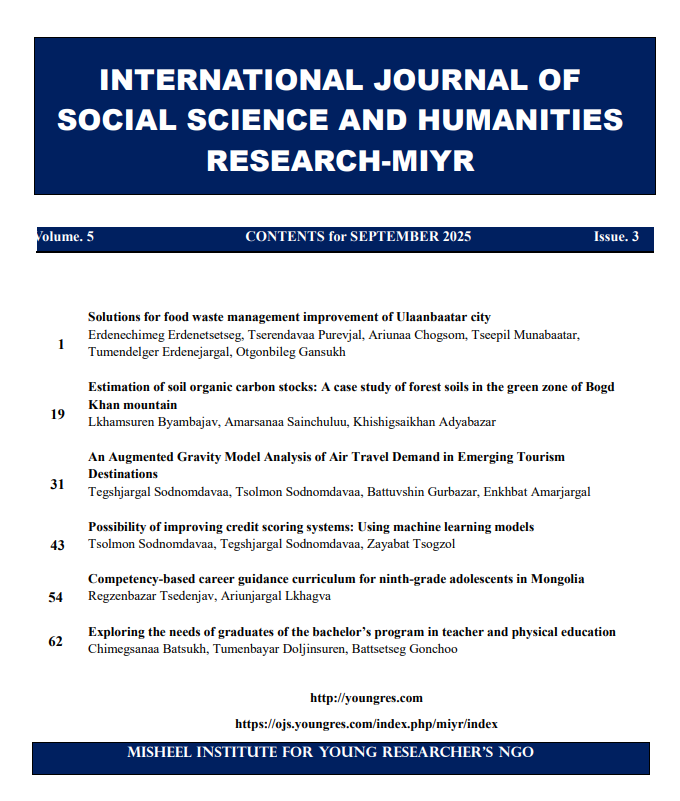
Competency-based career guidance curriculum for ninth-grade adolescents in Mongolia
DOI:
https://doi.org/10.53468/ijsshr-miyr.v5i3.5Keywords:
Career guidance, Competency-based education, AdolescentsAbstract
This study evaluates the impact of a competency-based supplementary career guidance curriculum on ninth-grade students in Mongolia, with particular emphasis on their knowledge, motivation, and actions related to career choice competence. A quasi-experimental design with pre- and post-test measures was employed, involving 196 participants. Data analysis was conducted using descriptive statistics, paired-sample t-tests, and correlation analysis to assess the intervention’s effectiveness. Results indicated a 25.9% improvement in overall competence, with strong correlations (r > .90) among knowledge, motivation, and action. Tables and figures demonstrated significant differences between pre- and post-test results, confirming the effectiveness of the competency-based approach. The findings suggest that the competency-based supplementary curriculum strengthens students’ knowledge, motivation, and decision-making skills, thereby enhancing their overall career choice competence. Integrating such competency based career guidance into the general education curriculum may better support adolescents in making informed career decisions, consistent with contemporary career development theories.
References
Lkhagva, A., & Tsedenjav, R. (2025). An investigation into the development of career choice competence among ninth grade adolescents in Mongolia. International Journal of Social Sciences, 5(1), 38–45. doi.org/10.53468/mifyr.2025.05.01.38
Driesel-Lange, K. (2020). Strukturen für individuelle berufliche Entwicklungen schaffen [Creating structures for individual career development]. Pädagogik, 1, 30–33. doi.org/10.3262/PAED2001030
Super, D. E. (1957). The psychology of careers. New York, NY: Harper & Row.
Holland, J. L. (1959). A theory of vocational choice. Journal of Counseling Psychology, 6(1), 35–45. doi.org/10.1037/h0040767
Krumboltz, J. D. (1976). A social learning theory of career decision making. In A. M. Mitchell, G. B. Jones, & J. D. Krumboltz (Eds.), Social learning and career decision making (pp. 19–49). Cranbury, NJ: Plexus.
Gottfredson, L. S. (1981). Circumscription and compromise: A developmental theory of occupational aspirations. Journal of Counseling Psychology, 28(6), 545–579. doi.org/10.1037/0022-0167.28.6.545
European Commission. (2020). European framework for key competences in lifelong learning. Luxembourg: Publications Office of the European Union. doi.org/10.2766/586540
Kim, H., & Park, S. (2021). Effects of competency-based career guidance on adolescents’ career readiness. Journal of Career Development, 48(2), 123–138. doi.org/10.1177/0894845320956458
Super, D. E. (1990). A life-span, life-space approach to career development. In D. Brown & L. Brooks (Eds.), Career choice and development (2nd ed., pp. 197–261). San Francisco, CA: Jossey-Bass.
Holland, J. L. (1997). Making vocational choices: A theory of vocational personalities and work environments (3rd ed.). Odessa, FL: Psychological Assessment Resources.
Gottfredson, L. S. (2002). Gottfredson’s theory of circumscription, compromise, and selfcreation. In D. Brown & Associates (Eds.), Career choice and development (4th ed., pp. 85–148). San Francisco, CA: Jossey-Bass.
Savickas, M. L. (2013). Career construction theory and practice. In R. W. Lent & S. D. Brown (Eds.), Career development and counseling: Putting theory and research to work (2nd ed., pp. 147–183). Hoboken, NJ: Wiley.
Kaak, P. (2013). Assessment of career decision-making competence: A conceptual framework. Berlin: Springer.
Lipowski, T. (2015). Motivation and competence in career guidance: Measurement tools and applications. Munich: De Gruyter.
Downloads
Published
How to Cite
Issue
Section
Categories
License
Copyright (c) 2025 Regzenbazar Tsedenjav, Ariunjargal Lkhagva

This work is licensed under a Creative Commons Attribution 4.0 International License.


