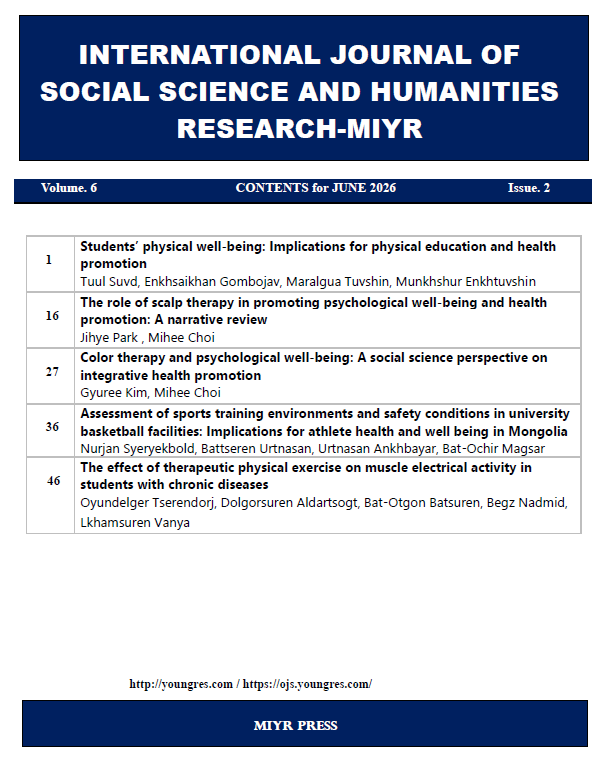
Students’ physical well-being: Implications for physical education and health promotion
DOI:
https://doi.org/10.53468/mifyr.2026.6.2.1Keywords:
Student well-being, Health promotion, Physical education, Inclusive educationAbstract
This study aims to examine how gender, sport participation, and regional background are related to university students’ physical well-being and provide implications for improving physical education programs. A total of 704 students participated in the study, including 92 males (13.1%) and 612 females (86.9%). Data were collected through standardized physical fitness tests, including a 50 m sprint (speed) and endurance assessment. Independent samples t-tests and one-way ANOVA were conducted using SPSS software to analyze group differences. The results revealed statistically significant gender differences in both speed (t(702) = −9.75, p < .001) and endurance (t(702) = −12.08, p < .001). Male students demonstrated significantly faster sprint performance, whereas female students showed higher endurance levels. No significant differences in speed were found across sport types (p = .382), suggesting that speed is a general physical fitness attribute. However, endurance varied partially across sport types, with dance students outperforming others in certain comparisons. Additionally, regional differences indicated that students from rural areas performed better in speed compared to those from urban environments. The findings highlight the importance of differentiated physical education curricula that consider gender, sport-specific characteristics, and lifestyle factors. These results provide evidence-based insights for improving physical education programs in higher education. Physical fitness is a key indicator of health and functional capacity, encompassing flexibility, muscular strength, endurance, and explosive power. Among university students, engagement in different sports may lead to distinct physiological adaptations due to sport-specific demands. Previous studies have shown that training type influences physical performance outcomes, particularly in strength-and power-related activities. However, limited research has compared multiple fitness components simultaneously across sport types, gender, and regional differences within a single population.
References
[1] Tuul, S., ChunYan, & Oyundari, T. (2025). Improving student physical training through inclusive and differentiated approaches. International Journal of Social Science and Humanities Research-MIYR, 5(2), 84–101. https://doi.org/10.53468/mifyr.2025.05.02.84
[2] Tuul, S., ChunYan, & Oyundari, T. (2022). Study of the physical development and preparedness of non-physical education students: On the example of Hulunbeier University. Lavai - International Journal of Education, 18(27), 14–23. https://doi.org/10.5564/lavai.v18i27.2494
[3] Tuul, S., Munkhbayar, N., et al. (2024). Culturally responsive school leadership and education for sustainable development. International Journal of Social Science and Humanities Research-MIYR, 4(1), 51–62. https://doi.org/10.53468/mifyr.2024.04.01.51
[4] Tremblay, M. S., Aubert, S., Barnes, J. D., Saunders, T. J., Carson, V., Latimer-Cheung, A. E., Chastin, S. F. M., Altenburg, T. M., & Chinapaw, M. J. M. (2017). Sedentary Behavior Research Network (SBRN): Terminology consensus project process and outcome. International Journal of Behavioral Nutrition and Physical Activity, 14(1), Article 75. https://doi.org/10.1186/s12966-017-0525-8
[5] Fagaras, S.-P., Radu, L.-E., & Vanvu, G. (2015). The level of physical activity of university students. Procedia - Social and Behavioral Sciences, 197, 1454–1457. https://doi.org/10.1016/j.sbspro.2015.07.094
[6] Gallotta, M. C., et al. (2024). Physical activity and academic performance in university students. Journal of Sports Science & Medicine, 23(1), 45–52.
[7] World Health Organization. (2020). WHO guidelines on physical activity and sedentary behaviour. World Health Organization. https://www.who.int/publications/i/item/9789240015128
[8] Keating, X. D., Guan, J., Piñero, J. C., & Bridges, D. M. (2005). A meta-analysis of college students' physical activity behaviors. Journal of American College Health, 54(2), 116–126. https://doi.org/10.3200/JACH.54.2.116-126
[9] Owen, N., Healy, G. N., Matthews, C. E., & Dunstan, D. W. (2010). Too much sitting: The population-health science of sedentary behavior. Exercise and Sport Sciences Reviews, 38(3), 105–113. https://doi.org/10.1097/JES.0b013e3181e373a2
[10] Biddle, S. J. H., & Asare, M. (2011). Physical activity and mental health in children and adolescents: A review of reviews. British Journal of Sports Medicine, 45(11), 886–895. https://doi.org/10.1136/bjsports-2011-090185
[11] UNESCO. (2015). Quality physical education (QPE): Guidelines for policy-makers. UNESCO Publishing.
[12] Bompa, T. O., & Buzzichelli, C. (2019). Periodization: Theory and methodology of training (6th ed.). Human Kinetics.
[13] McArdle, W. D., Katch, F. I., & Katch, V. L. (2015). Exercise physiology: Nutrition, energy, and human performance (8th ed.). Wolters Kluwer.
[14] Young, W., James, R., & Montgomery, I. (2001). Is muscle power related to running speed? Journal of Sports Medicine, 35(1), 13–19.
[15] Kenney, W. L., Wilmore, J. H., & Costill, D. L. (2020). Physiology of sport and exercise (7th ed.). Human Kinetics.
[16] Sallis, J. F., et al. (2016). Physical activity in relation to urban environments. The Lancet, 387(10034), 2207–2217.
[17] Fagaras, S.-P., Radu, L.-E., & Vanvu, G. (2015). The level of physical activity of university students. Procedia - Social and Behavioral Sciences, 197, 1454–1457. https://doi.org/10.1016/j.sbspro.2015.07.094
[18] Lloyd, R. S., & Oliver, J. L. (2012). The youth physical development model: A new approach to long-term athletic development. Strength and Conditioning Journal, 34(3), 61–72. https://doi.org/10.1519/SSC.0b013e31825760ea
Downloads
Published
How to Cite
Issue
Section
Categories
License
Copyright (c) 2026 Tuul Suvd, Enkhsaikhan Gombojav, Maralgua Tuvshin, Munkhshur Enkhtuvshin

This work is licensed under a Creative Commons Attribution 4.0 International License.


