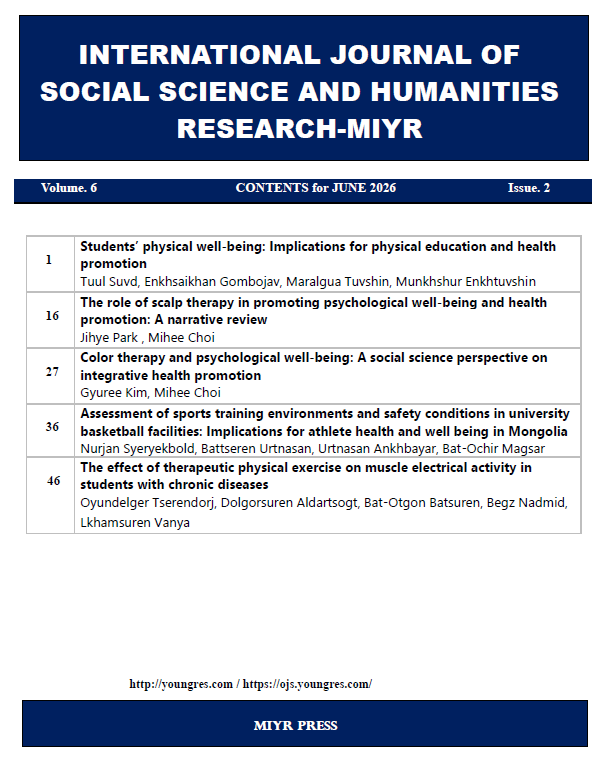
The role of scalp therapy in promoting psychological well-being and health promotion: A narrative review
DOI:
https://doi.org/10.53468/mifyr.2026.6.2.16Keywords:
Scalp Therapy, Psychological Well-being, Stress Management, Wellness, Quality of Life, Integrative Health MedicineAbstract
This narrative review explored the psychophysiological mechanisms of scalp therapy and its potential role in promoting psychological well-being within integrative health medicine. The scalp is rich in blood vessels, sensory nerves, and hair follicles, making it highly responsive to external stimulation and closely linked to autonomic and emotional regulation. The literature suggests that scalp therapy may support autonomic nervous system balance, regulate stress responses through the hypothalamic–pituitary–adrenal (HPA) axis, and improve blood circulation. Tactile, olfactory, and thermal stimulation may promote relaxation, emotional stability, and stress reduction through interactions with the limbic system. As a non-invasive and accessible intervention, scalp therapy may benefit individuals experiencing chronic stress and contribute to wellness and preventive health programs, particularly when combined with complementary approaches such as aromatherapy and meditation. Further studies using standardized protocols and objective measures are needed to confirm its effectiveness and broader applicability.
References
[1]Thomas, S.(2023).Health as Complete Well-Being: The WHO Definition and Beyond, Public Health Ethics, Volume 16, Issue 3, November 2023, Pages 210–218, https://doi.org/10.1093/phe/phad017
[2]Ntoumas, I., et al. (2025). The impact of relaxation massage prior to bedtime on sleep efficiency. Healthcare, 13(2), 180. https://doi.org/10.3390/healthcare13020180
[3]Chrousos, G. P. (2009). Stress and disorders of the stress system. Nature Reviews Endocrinology, 5(7), 374–381. http://dx.doi.org/10.1038/nrendo.2009.106
[4]Arck, P. C., et al. (2006). Neuroimmunology of stress: Skin takes center stage. Journal of Investigative Dermatology, 126(8), 1697–1704.https://doi.org/10.1038/sj.jid.5700104
[5]Field, T. (2016). Massage therapy research review. Complementary Therapies in Clinical Practice, 24, 19–31. https://doi.org/10.1016/j.ctcp.2016.04.005
[6]Moraska, A., et al. (2010). Massage and stress response. Complementary Therapies in Medicine, 18(3–4), 105–112.
[7]Park, J.-H., & Choi, M.-H. (2023). A study on the effects of shampoo and scalp serum on scalp and hair loss improvement made with defined cell culture media 4. International Journal of Social Science and Humanities Research-MIYR, 3(2), 1~22. https://doi.org/10.53468/mifyr.2023.03.02.01
[8]Koyama, T., et al. (2016). Standardized scalp massage results in increased hair thickness. Eplasty, 16, e8.
[9]Kim, H. J., et al. (2018). Effects of scalp massage on stress hormone, blood pressure, and heart rate. Journal of Physical Therapy Science, 30(5), 623–627.
[10]National Center for Complementary and Integrative Health. (2021). Whole person health: What it is and why it’s important. https://www.nccih.nih.gov
[11]Trüeb, R. M. (2015). The value of hair cosmetics and pharmaceuticals. Dermatology, 231(2), 95–98.
[12]Paus, R., & Cotsarelis, G. (1999). The biology of hair follicles. New England Journal of Medicine, 341(7), 491–497. https://doi.org/:10.1056/NEJM199908123410706
[13] Draelos, Z. D. (2010). Hair care and treatment. Dermatologic Clinics, 28(3), 431–438.
[14]Herz, R. S. (2009). Aromatherapy facts and fictions. International Journal of Neuroscience, 119(2), 263–290. https://doi.org/10.1080/00207450802333953
[15]Malkud, S. (2015). Telogen effluvium: A review. Journal of Clinical and Diagnostic Research, 9(9), WE01–WE03.
[16]Vora, L. K., et al. (2024). Essential oils for clinical aromatherapy: A comprehensive review. Journal of Ethnopharmacology.
[17]Mortada, E. M., et al. (2024). Evidence-based complementary and alternative medicine in healthcare.
[18] Diego, M. A., & Field, T. (2009). Moderate pressure massage. International Journal of Neuroscience, 119(5), 630–638.https://doi.org/10.1080/00207450802329605
[19]Field, T., et al.(2005). Cortisol decreases and serotonin and dopamine increase following massage therapy. Int J Neurosci, 115(10), 1397–1413. https://doi.org/10.1080/00207450590956459
[20]Moraska, A., et al. (2010). Massage and stress response. Complementary Therapies in Medicine, 18(3–4), 105–112.
[21]Uvnas-Moberg, K. (1998). Oxytocin may mediate the benefits of touch. Psychoneuroendocrinology, 23(8), 819–835.
[22] Ulrich-Lai, Y. M., & Herman, J. P. (2009). Neural regulation of endocrine and autonomic stress responses.Nature Reviews Neuroscience, 10(6), 397–409.https://doi.org/10.1038/nrn2647
[23]Wieland, L. S., et al. (2011). Complementary and alternative medicine classification. Alternative Therapies in Health and Medicine, 17(2), 50–59.
[24] López-Otín, C. (2024). The missing hallmark of health: Psychosocial adaptation. Proceedings of the National Academy of Sciences (PNAS).
[25]Akyüz, H. Ö., et al. (2024). The effect of aromatherapy massage on pain severity and quality of life in acute migraine attacks. Florence Nightingale Journal of Nursing, 32(2), 159–167. https://doi.org/10.5152/FNJN.2024.23235
Downloads
Published
How to Cite
Issue
Section
Categories
License
Copyright (c) 2026 Jihye Park , Mihee Choi

This work is licensed under a Creative Commons Attribution 4.0 International License.


