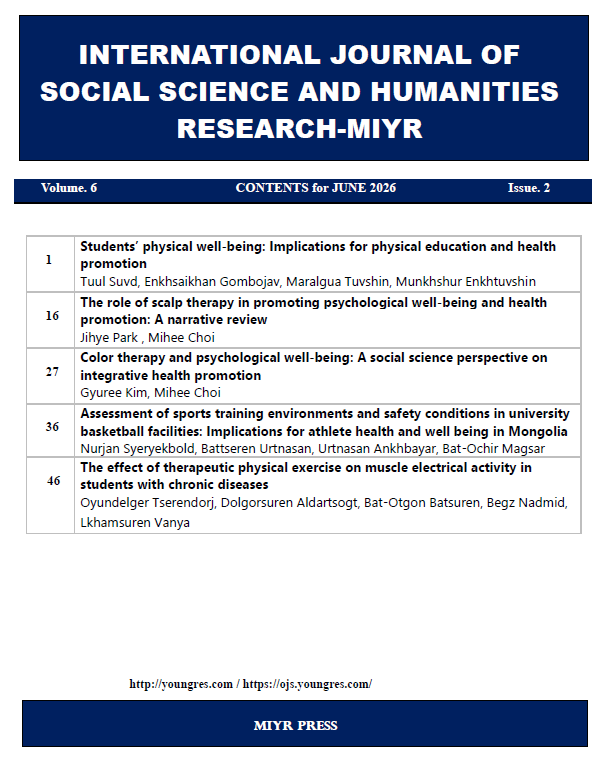
The effect of therapeutic physical exercise on muscle electrical activity in students with chronic diseases
DOI:
https://doi.org/10.53468/mifyr.2026.6.2.46Keywords:
Therapeutic exercise; Surface electromyography; Muscle strength; Physical education; NoraxonAbstract
Abstract- Physical inactivity among children and adolescents is a growing public health concern associated with impaired physical development, reduced muscle strength, poor motor coordination, and an increased risk of non-communicable diseases. Students with chronic diseases frequently experience restricted participation in physical education, highlighting the need for evidence-based therapeutic exercise programs that support their physical functioning and promote inclusive participation in school-based physical activity. To investigate the effects of a therapeutic physical exercise program on muscle strength and muscle electrical activity in students with chronic diseases. A single-group quasi-experimental study was conducted with 30 secondary school students diagnosed with chronic diseases. Anthropometric characteristics, flexibility, handgrip strength, back muscle strength, and waist and hip circumferences were assessed before and after the intervention. Surface electromyography (sEMG) using a Noraxon system was performed to evaluate the electrical activity of the rectus abdominis, rectus femoris, thoracic erector spinae, and gastrocnemius muscles. Data were analyzed using descriptive statistics, paired and independent t-tests, Pearson correlation analysis, one-way analysis of variance (ANOVA), and Cohen's d effect size. Statistical significance was established at p < 0.05. Following the therapeutic exercise program, significant improvements were observed in flexibility, handgrip strength, and back muscle strength. Surface EMG demonstrated significant reductions in the electrical activity of all examined muscles during follow-up measurements (p < 0.001), indicating greater neuromuscular efficiency. Strong positive correlations between baseline and follow-up EMG measurements (r = 0.946–0.988) confirmed the high reliability of the measurements. Large effect sizes further supported the effectiveness of the intervention. Therapeutic physical exercise significantly enhanced muscle strength, flexibility, and neuromuscular efficiency in students with chronic diseases. These findings suggest that school-based therapeutic exercise programs may represent an effective strategy for improving physical function and supporting inclusive physical education for students with chronic health conditions.
References
[1] World Health Organization. (2020). WHO guidelines on physical activity and sedentary behaviour.
[2] Strong, W. B., Malina, R. M., Blimkie, C. J. R., Daniels, S. R., Dishman, R. K., Gutin, B., Hergenroeder, A. C., Must, A., Nixon, P. A., Pivarnik, J. M., Rowland, T., Trost, S., & Trudeau, F. (2005). Evidence based physical activity for school-age youth. The Journal of Pediatrics, 146(6), 732–737. https://doi.org/10.1016/j.jpeds.2005.01.055
[3] Janssen, I., & LeBlanc, A. G. (2010). Systematic review of the health benefits of physical activity and fitness in school-aged children and youth. International Journal of Behavioral Nutrition and Physical Activity, 7(1), Article 40. https://doi.org/10.1186/1479-5868-7-40
[4] Ortega, F. B., Ruiz, J. R., Castillo, M. J., & Sjöström, M. (2008). Physical fitness in childhood and adolescence: A powerful marker of health. International Journal of Obesity, 32(1), 1–11. https://doi.org/10.1038/sj.ijo.0803774
[5] Bailey, R. (2006). Physical education and sport in schools: A review of benefits and outcomes. Journal of School Health, 76(8), 397–401. https://doi.org/10.1111/j.1746-1561.2006.00132.x
[6] Trudeau, F., & Shephard, R. J. (2008). Physical education, school physical activity, school sports and academic performance. International Journal of Behavioral Nutrition and Physical Activity, 5(1), Article 10. https://doi.org/10.1186/1479-5868-5-10
[7] Sallis, J. F., McKenzie, T. L., Beets, M. W., Beighle, A., Erwin, H., & Lee, S. (2012). Physical education's role in public health. Research Quarterly for Exercise and Sport, 83(2), 125–135. https://doi.org/10.1080/02701367.2012.10599842
[8] Fairclough, S., & Stratton, G. (2005). Physical activity levels in middle and high school physical education: A review. Pediatric Exercise Science, 17(3), 217–236. https://doi.org/10.1123/pes.17.3.217
[9] Rimmer, J. A., & Rowland, J. L. (2008). Physical activity for youth with disabilities: A critical need in an underserved population. Developmental Neurorehabilitation, 11(2), 141–148. https://doi.org/10.1080/17518420701688649
[10] Verschuren, O., Peterson, M. D., Balemans, A. C. J., & Hurvitz, E. A. (2016). Exercise and physical activity recommendations for people with cerebral palsy. Developmental Medicine & Child Neurology, 58(8), 798–808. https://doi.org/10.1111/dmcn.13053
[11] Piercy, K. L., Troiano, R. P., Ballard, R. M., Carlson, S. A., Fulton, J. E., Galuska, D. A., George, S. M., & Olson, R. D. (2018). The physical activity guidelines for Americans. JAMA, 320(19), 2020–2028. https://doi.org/10.1001/jama.2018.14854
[12] Kisner, C., Colby, L. A., & Borstad, J. (2018). Therapeutic exercise: Foundations and techniques (7th ed.). F. A. Davis.
[13] Faigenbaum, A. D., Kraemer, W. J., Blimkie, C. J. R., Jeffreys, I., Micheli, L. J., Nitka, M., & Rowland, T. W. (2009). Youth resistance training: Updated position statement paper from the National Strength and Conditioning Association. Journal of Strength and Conditioning Research, 23(5 Suppl.), S60–S79. https://doi.org/10.1519/JSC.0b013e31819df407
[14] Lloyd, R. S., Oliver, J. L., Faigenbaum, A. D., Howard, R., De Ste Croix, M. B., Williams, C. A., Best, T. M., Alvar, B. A., Micheli, L. J., Thomas, D. P., Hatfield, D. L., & Cronin, J. B. (2015). Long-term athletic development—Part 1: A pathway for all youth. Journal of Strength and Conditioning Research, 29(5), 1439–1450. https://doi.org/10.1519/JSC.0000000000000756
[15] De Luca, C. J. (1997). The use of surface electromyography in biomechanics. Journal of Applied Biomechanics, 13(2), 135–163. https://doi.org/10.1123/jab.13.2.135
[16] Farina, D., Merletti, R., & Enoka, R. M. (2004). The extraction of neural strategies from the surface EMG. Journal of Applied Physiology, 96(4), 1486–1495. https://doi.org/10.1152/japplphysiol.01070.2003
[17] Häkkinen, K., Alen, M., Kallinen, M., Newton, R. U., & Kraemer, W. J. (2000). Neuromuscular adaptation during prolonged strength training, detraining and re-strength-training in middle-aged and elderly people. European Journal of Applied Physiology, 83(1), 51–62. https://doi.org/10.1007/s004210000248
[18] Aagaard, P., Simonsen, E. B., Andersen, J. L., Magnusson, P., & Dyhre-Poulsen, P. (2002). Increased rate of force development and neural drive of human skeletal muscle following resistance training. Journal of Applied Physiology, 93(4), 1318–1326. https://doi.org/10.1152/japplphysiol.00283.2002
[19] Escamilla, R. F., Yamashiro, K., Paulos, L., & Andrews, J. R. (2009). Shoulder muscle activity and function in common shoulder rehabilitation exercises. Sports Medicine, 39(8), 663–685. https://doi.org/10.2165/00007256-200939080-00004
[20 ]Andersen, L. L., Magnusson, S. P., Nielsen, M., Haleem, J., Poulsen, K., & Aagaard, P. (2006). Neuromuscular activation in conventional therapeutic exercises and heavy resistance exercises: Implications for rehabilitation. Physical Therapy, 86(5), 683–697. https://doi.org/10.1093/ptj/86.5.683
[21] Falk, B., & Dotan, R. (2006). Child-adult differences in the recovery from high-intensity exercise. Exercise and Sport Sciences Reviews, 34(3), 107–112. https://doi.org/10.1249/00003677-200607000-00004
[22] Lloyd, R. S., & Oliver, J. L. (2012). The youth physical development model. Strength and Conditioning Journal, 34(3), 61–72. https://doi.org/10.1519/SSC.0b013e31825760ea
[23] Behm, D. G., Young, J. D., Whitten, J. H. D., Reid, J. C., Quigley, P. J., Low, J., Li, Y., Lima, C. D., Hodgson, D. D., Chaouachi, A., Prieske, O., Granacher, U., & Ramirez-Campillo, R. (2017). Effectiveness of traditional strength vs. power training on muscle strength, power and speed with youth: A systematic review and meta-analysis. Frontiers in Physiology, 8, Article 423. https://doi.org/10.3389/fphys.2017.00423
[24] Lloyd, R. S., Faigenbaum, A. D., Stone, M. H., Oliver, J. L., Jeffreys, I., Moody, J. A., Brewer, C., Pierce, K. C., McCambridge, T. M., Howard, R., Herrington, L., Hainline, B., Micheli, L. J., Jaques, R., Kraemer, W. J., Best, T. M., Chu, D. A., Alvar, B. A., & Myer, G. D. (2014). Position statement on youth resistance training: The 2014 international consensus. British Journal of Sports Medicine, 48(7), 498–505. https://doi.org/10.1136/bjsports-2013-092952
[25] Enoka, R. M., & Duchateau, J. (2016). Translating fatigue to human performance. Medicine & Science in Sports & Exercise, 48(11), 2228–2238. https://doi.org/10.1249/MSS.0000000000000929
[26] Malina, R. M., Bouchard, C., & Bar-Or, O. (2004). Growth, maturation, and physical activity (2nd ed.). Human Kinetics.
[27] Oyundelger Tserendorj, Dolgorsuren Aldartsogt, Bat-Otgon Batsuren, Begz Nadmid, Lkhamsuren Vanya. Effects of therapeutic exercises on physical development in students with pathological conditions. International Journal of Social Science and Humanities Research-MIYR, 2026, 6(1), 64~72.https://doi.org/10.53468/mifyr.2026.6.1.64
Downloads
Published
How to Cite
Issue
Section
Categories
License
Copyright (c) 2026 Oyundelger Tserendorj, Dolgorsuren Aldartsogt, Bat-Otgon Batsuren, Begz Nadmid, Lkhamsuren Vanya

This work is licensed under a Creative Commons Attribution 4.0 International License.


