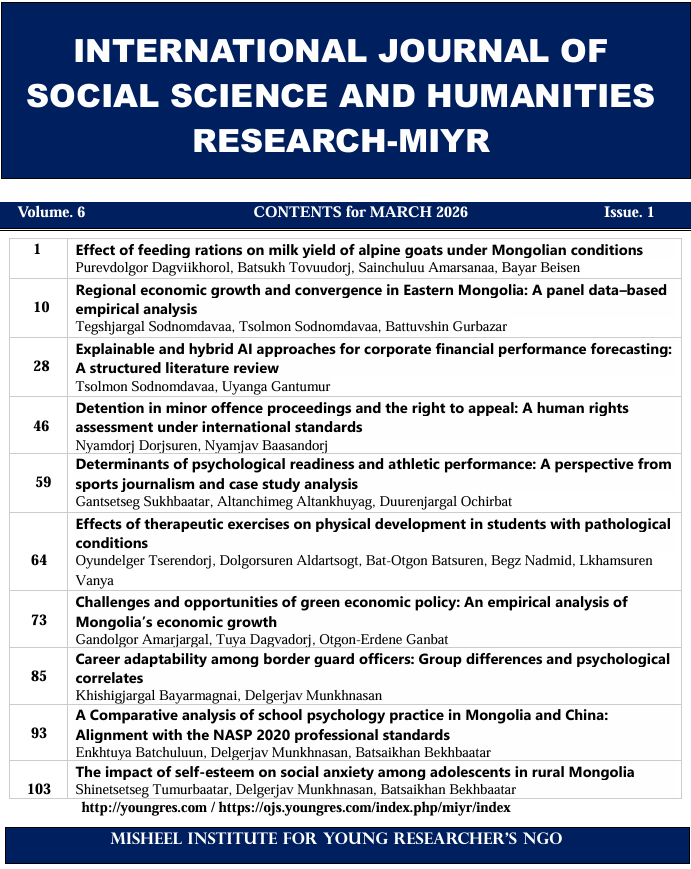
A Comparative analysis of school psychology practice in Mongolia and China: Alignment with the NASP 2020 professional standards
DOI:
https://doi.org/10.53468/mifyr.2026.6.1.93Keywords:
School psychologist, NASP 2020, Functional mapping, Comparative policy analysis, Professional standardsAbstract
School psychological services play a critical role in promoting educational equity and supporting student mental health. Although Mongolia introduced 22 legal mandates for school psychologists in 2021, their alignment with international benchmarks—particularly the NASP 2020 Practice Model—has not yet been systematically evaluated. This study applies a functional mapping methodology to comparatively analyze school psychology frameworks in Mongolia and China. National mandates were systematically mapped against the 10 domains and 92 practice indicators of the NASP 2020 model to assess structural alignment and identify professional gaps. The results indicate that Mongolia’s mandates exhibit approximately 90% alignment at the macro-domain level; however, notable micro-level imbalances persist. Significant professional voids were identified in Legal–Ethical Practice (Domain 10) and Data-Based Decision-Making (Domain 1), while relative strengths were observed in family–school–community collaboration (Domains 7 and 8). To address these disparities, a phased “22+8+10” operational mapping strategy is proposed, outlining an expansion toward 40 core professional functions by 2030. This operational mapping provides a feasible pathway for Mongolia to achieve parity with international standards while strengthening context-specific practices.
References
MacKay, T. (2005). The relationship of educational psychology and clinical neuropsychology. Educational and Child Psychology, 22(2), 7–17. https://doi.org/10.53841/bpsecp.2005.22.2.7
Stobie, I. (2002). Processes of “change” and “continuity” in educational psychology—Part II. Educational Psychology in Practice, 18(3), 213–237. https://doi.org/10.1080/0266736022000010258
Delgerjav, M., & Batsaikhan, B. (2024). Educational psychology (Vol. 3). Soyonbo Printing.
Enkhtuya, B., & Orgil, B. (2025). A study on challenges and solutions for school psychologists. Educational Studies, 25(611), 238–242.
Oakland, T., & Hu, S. (1993). International perspectives on tests used with children and youths. Journal of School Psychology, 31(4), 501–517. https://doi.org/10.1016/0022-4405(93)90034-G
Oakland, T., & Jimerson, S. R. (2007). School psychology internationally: A retrospective view and influential conditions. In S. R. Jimerson, T. Oakland, & P. Farrell (Eds.), The handbook of international school psychology (pp. 453–462). SAGE Publications. https://doi.org/10.4135/9781412976138.n45
Liu, Y., Qu, X., & Hilts, D. (2025). School counseling development and practice in China: A 20-year systematic review. Asia Pacific Education Review. Advance online publication. https://doi.org/10.1007/s12564-025-10045-2
Krach, S. K., Dixon, R. J., Daly, B. D., & Rao, A. (2025). Roles, responsibilities, and provided supports for school psychology faculty. Contemporary School Psychology, 29(4), 743–764. https://doi.org/10.1007/s40688-024-00534-3
Goforth, A. N., Farmer, R. L., Kim, S. Y., Naser, S. C., Lockwood, A. B., & Affrunti, N. W. (2021). Status of school psychology in 2020: Part 1, demographics of the NASP membership survey (NASP research reports). National Association of School Psychologists.
Fenning, P., Pearrow, M., & Politikos, N. (2023). NASP 2020 professional practice standards: Applications and opportunities for school-based consultation. Journal of Educational and Psychological Consultation, 33(1), 1–9. https://doi.org/10.1080/10474412.2022.2154675
Raash, N., Dulamsuren, B., & Tsogtbayar, M. (2024). Mongolian students’ learning style and experiential learning outcomes. International Journal of Social Science and Humanities Research, 5(4), 43–60. https://doi.org/10.53468/mifyr.2025.5.4.43
Ministry of Education of the People’s Republic of China. (2012). Guidelines for psychological health education in primary and secondary schools. Ministry of Education.
Jimerson, S. R., Annan, J., Skokut, M., & Renshaw, T. L. (2009). Educational psychology in New Zealand: Results of the 2006 international school psychology survey. School Psychology International, 30(5), 443–455. https://doi.org/10.1177/0143034309341617
National Association of School Psychologists. (2020). The model for comprehensive and integrated school psychological services (NASP practice model).
Hatzichristou, C., Georgakakou-Koutsonikou, A., Lianos, P., Lampropoulou, A., & Yfanti, T. (2017). Assessing school communities’ needs and subjective well-being: A holistic approach to resilience and positive development. International Journal of School & Educational Psychology, 5(2), 107–109. https://doi.org/10.1080/21683603.2016.1215514
Downloads
Published
How to Cite
Issue
Section
Categories
License
Copyright (c) 2026 Enkhtuya Batchuluun, Delgerjav Munkhnasan, Batsaikhan Bekhbaatar

This work is licensed under a Creative Commons Attribution 4.0 International License.


