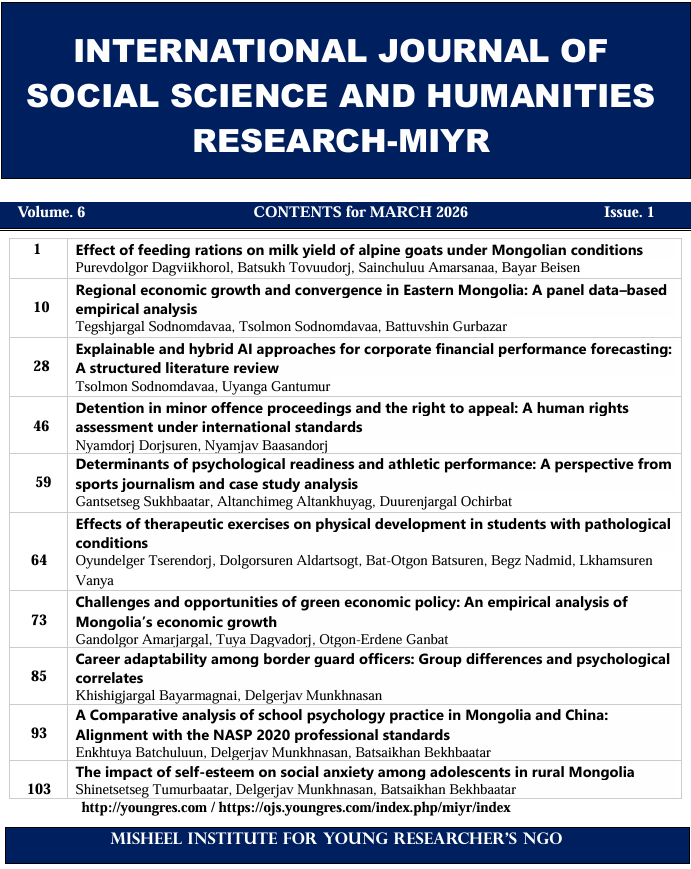
Career adaptability among border guard officers: Group differences and psychological correlates
DOI:
https://doi.org/10.53468/mifyr.2026.6.1.85Keywords:
Career adaptability, Border guard officers, Military psychology, Career development, Career Adapt-Abilities ScaleAbstract
Career adaptability is an important psychological resource that enables individuals to effectively manage career-related challenges and transitions. The present study aimed to examine the level and selected characteristics of career adaptability among officers serving in the Mongolian border protection organization using the Career Adapt-Abilities Scale (CAAS). A total of 520 officers participated in the study, representing different ranks, regions, and demographic groups. The results indicated that officers demonstrated a relatively high level of career adaptability (M = 85.91, SD = 20.99). Among the four dimensions, confidence showed the highest mean score, whereas concern demonstrated comparatively lower levels. Independent samples t-tests revealed no statistically significant gender differences. Similarly, one-way ANOVA results indicated no significant differences across rank and regional categories. However, exploratory post hoc comparisons may suggest potential differences in concern and confidence across certain groups, although these findings should be interpreted with caution. Overall, the findings highlight the importance of career adaptability as a key psychological resource in military contexts and provide practical implications for personnel development and organizational support strategies.
References
Savickas, M. L. (2005). The theory and practice of career construction. In S. D. Brown & R. W. Lent (Eds.), Career development and counseling: Putting theory and research to work (pp. 42–70). John Wiley & Sons. https://www.marksavickas.com/files/1_Savickas_bio/Interviews/Savickas%20Publications/Book%20Chapters/Theory_and_Practice_of_Career_Construction.pdf
Savickas, M. L., & Porfeli, E. J. (2012). Career adapt-abilities scale: Construction, reliability, and measurement equivalence across 13 countries. Journal of Vocational Behavior, 80(3), 661–673. https://doi.org/10.1016/j.jvb.2012.01.011
Savickas, M. L. (2013). Career construction theory and practice. In S. D. Brown & R. W. Lent (Eds.), Career development and counseling: Putting theory and research to work (2nd ed., pp. 147–183). John Wiley & Sons. https://library.uniq.edu.iq/storage/books/file/Career%20Development%20and%20Couseling/1667986287car.pdf
Rudolph, C. W., Lavigne, K. N., & Zacher, H. (2017). Career adaptability: A meta-analysis of relationships with measures of adaptivity, adapting responses, and adaptation results. Journal of Vocational Behavior, 98, 17–34. https://doi.org/10.1016/j.jvb.2016.09.002
Nota, L., & Rossier, J. (2015). Life design: A paradigm for career construction. In L. Nota & J. Rossier (Eds.), Handbook of life design: From practice to theory and from theory to practice (pp. 3–20). Hogrefe. https://pubengine2.s3.eu-central-1.amazonaws.com/preview/99.110005/9781616764470_preview.pdf
Ginevra, M. C., Di Maggio, I., Santilli, S., Gati, I., & Nota, L. (2017). The role of career adaptability and courage on life satisfaction in adolescence. Journal of Adolescence, 62, 1–8. https://doi.org/10.1016/j.adolescence.2017.11.002
Xu, X., Hu, T., Song, Y., & Liu, Y. (2020). The role of career adaptability and resilience in mental health problems in Chinese adolescents. Children and Youth Services Review, 112, 104893. https://doi.org/10.1016/j.childyouth.2020.104893
Baasandorj, N. B., & Munkhnasan, D. (2024). A study of depression in military personnel. International Journal of Social Science and Humanities Research, 4(1), 63–72. https://doi.org/10.53468/mifyr.2024.04.01.63
Downloads
Published
How to Cite
Issue
Section
Categories
License
Copyright (c) 2026 Khishigjargal Bayarmagnai, Delgerjav Munkhnasan

This work is licensed under a Creative Commons Attribution 4.0 International License.


