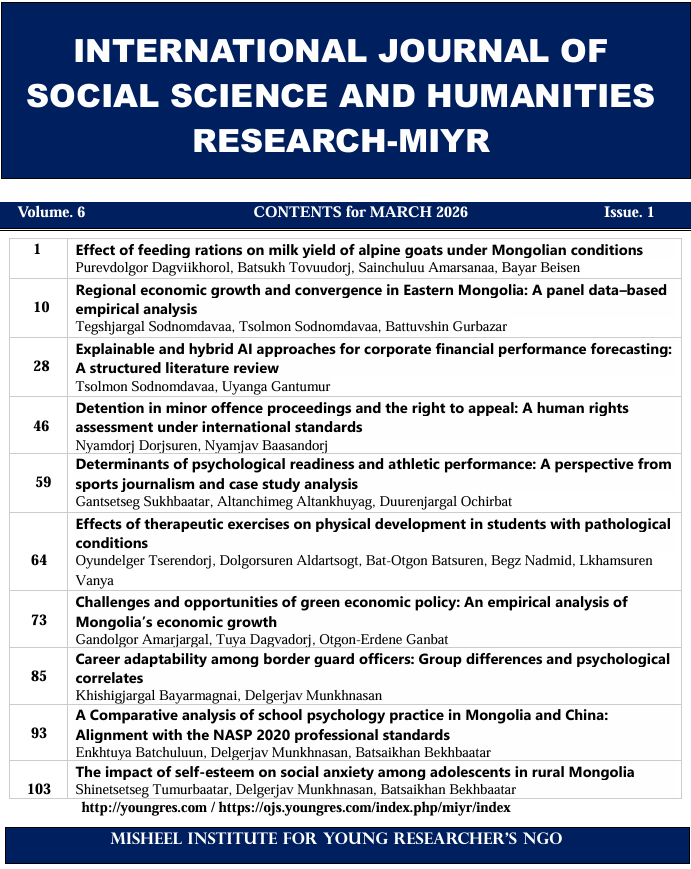
Challenges and opportunities of green economic policy: An empirical analysis of Mongolia’s economic growth
DOI:
https://doi.org/10.53468/mifyr.2026.6.1.73Keywords:
green economy, OLS, economic growth, ARDL, dynamic analysisAbstract
The primary objective of this study is to empirically examine the impact of key green economy indicators on Mongolia’s economic growth (GDP) over the period 1990–2024. The analysis employs variables such as value added in agriculture (VAA), consumption of renewable energy (CRE), carbon dioxide emissions (CDE), and per capita freshwater resources (PCW), using data processed through STATA 19 software. At the initial stage, the Ordinary Least Squares (OLS) regression results reveal that VAA exerts a statistically significant and positive influence on economic growth, whereas CRE demonstrates a positive effect at the marginal level of significance. Conversely, CDE and PCW show no discernible impact on GDP. In the subsequent stage, the Autoregressive Distributed Lag (ARDL) model is applied to explore the dynamic relationships among GDP, VAA, and CRE. The findings indicate that the previous year’s increase in VAA is negatively associated with current economic growth, implying a reversion effect. Moreover, short-term growth in CRE appears to have a contractionary effect on GDP, potentially due to transition costs and structural adjustments associated with renewable energy adoption. Overall, the empirical evidence suggests that while green economic policies are essential for promoting sustainable economic growth in Mongolia, targeted measures are needed to mitigate short-term transition costs and to stabilize agricultural output fluctuations during the transformation process.
References
Ahmed, K., & Qazi, A. Q. (2014). Environmental Kuznets curve for CO₂ emission in Mongolia: An empirical analysis. Management of Environmental Quality: An International Journal, 25(4), 505–516.
Apergis, N., & Payne, J. E. (2020). Renewable energy consumption and economic growth nexus: A 103-country sample. Renewable and Sustainable Energy Reviews.
Barbier, E. B. (2011). Is green growth relevant for poor economies? World Bank.
Emission Index. (n.d.). Greenhouse gas emissions in Mongolia.
Guo, J., et al. (2020). Greenhouse gas emissions embodied in the Mongolian economy. Journal of Cleaner Production.
International Energy Agency. (2024). Clean energy is boosting economic growth.
Ko, M. C., & Amarjargal, G. (2022). Economic integration and growth in East Asia: Panel data analysis. Korean Comparative Research Review, 8(2), 163–XX. https://doi.org/10.33575/KCRR.2022.8.2.163
Millennium Challenge Corporation. (2025). Mongolia water compact.
Morán-Guerrero, A., & Gsottbauer, E. (2024). World economies’ progress in decoupling from CO₂ emissions.
Pesaran, M. H., Shin, Y., & Smith, R. J. (2001). Bounds testing approaches to the analysis of level relationships. Journal of Applied Econometrics, 16(3), 289–326.
The GlobalEconomy.com. (2024). Mongolia GDP share of agriculture.
United Nations Development Programme. (2023). Mongolia’s sustainable future depends on a swift green transition.
World Bank. (2011). Is green growth relevant for poor economies?
Downloads
Published
How to Cite
Issue
Section
Categories
License
Copyright (c) 2026 Gandolgor Amarjargal, Tuya Dagvadorj, Otgon-Erdene Ganbat

This work is licensed under a Creative Commons Attribution 4.0 International License.


