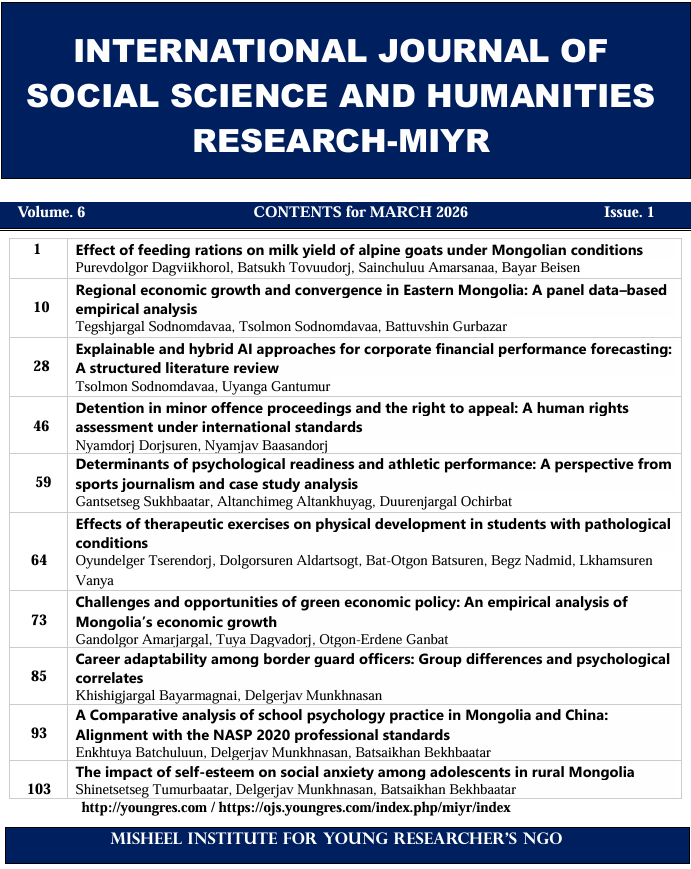
Effects of therapeutic exercises on physical development in students with pathological conditions
DOI:
https://doi.org/10.53468/mifyr.2026.6.1.64Keywords:
Physical activity; Muscle strength; Chronic conditionsAbstract
Rapid digitalization and reduced physical activity are associated with poorer physical development and increased non-communicable disease risk among youth. This study examined the effects of therapeutic exercise on students with pathological conditions exempt from physical education. A quasi-experimental single-group pre–post design included 30 secondary students with conditions such as diabetes and hypertension. A nine-month program was conducted twice weekly following the FITT principle. Data were analyzed using paired t-tests and effect sizes (p < 0.05). Flexibility improved by 3.70 cm, handgrip strength by 7.50 kg (right) and 6.92 kg (left), and back strength by 17.60 kg. Height and weight increased slightly. Effect sizes were moderate to high. Therapeutic exercise may enhance physical development, though findings are limited by small sample size and lack of a control group.
References
Asian Journal of Human Services. (2015). Longitudinal verification of the relationship between psychological, physiological and pathological changes and the outcome of classes. Asian Journal of Human Services, 9, 107–117. https://doi.org/10.14391/ajhs.9.107
Lkhamsuren, V., Oyundelger, Ts., & Bat-Otgon, B. (2025). Opportunities to prevent physical inactivity through physical education classes. Mongolian International Forum of Youth Research, 5(4), 61–72. https://doi.org/10.53468/mifyr.2025.5.4.61-72
Brittain, I. (2010). The role of schools in constructing self-perceptions of sport and physical education in relation to people with disabilities. Sport, Education and Society, 15(1), 75–94. https://doi.org/10.1080/1357332042000175827
Wang, L. (2019). Perspectives of students with special needs on inclusion in general physical education: A social-relational model of disability. Adapted Physical Activity Quarterly, 36(2), 242–263. https://doi.org/10.1123/apaq.2018-0068
Medekov, H. (2009). Physical activity and its relationship with selected indicators of somatic, functional and motor development. In Proceedings of VEGA Research Conference.
Тунгалаг, Ж. (2008). Нийтийн биеийн тамирыг бүх нийтийн үйлс болгох асуудал. Улаанбаатар: Сод Пресс.
Якунин, А. Н., & Кондрашова, Л. А. (2018). Medical rehabilitation and therapeutic physical training. St. Petersburg: SpetsLit.
Шойхет, Я. Н. (2012). ЛФК и массаж: практическое руководство. Москва: МЕДпресс-информ.
Kisner, C., & Colby, L. A. (2012). Therapeutic exercise: Foundations and techniques (6th ed.). F.A. Davis.
Bielecki, M., & Tadi, P. (2023). Therapeutic exercise. In StatPearls. StatPearls Publishing. https://www.ncbi.nlm.nih.gov/books/NBK555922/
American Physical Therapy Association. (2014). Guide to physical therapist practice 3.0. https://www.apta.org
Sandstedt, E., Fasth, A., Eek, M. N., et al. (2013). Muscle strength, physical fitness and well-being in children and adolescents with juvenile idiopathic arthritis and the effect of an exercise programme: A randomized controlled trial. Pediatric Rheumatology, 11, 7. https://doi.org/10.1186/1546-0096-11-7
Liu, W. Y., et al. (2024). Effect of exercise training on health, quality of life and exercise capacity in juvenile idiopathic arthritis: A meta-analysis of randomized controlled trials. Pediatric Rheumatology, 22(1), 33. https://doi.org/10.1186/s12969-024-00967-3
Pinho, C. D. F., Bagatini, N. C., Lisboa, S. D. C., et al. (2024). Effects of different supervised and structured physical exercise on the physical fitness trainability of children and adolescents: A meta-analysis and meta-regression. BMC Pediatrics, 24, 798. https://doi.org/10.1186/s12887-024-04929-2
Houghton, K. M., Macdonald, H. M., McKay, H. A., et al. (2018). Feasibility and safety of a 6-month exercise program to increase bone and muscle strength in children with juvenile idiopathic arthritis. Pediatric Rheumatology, 16, 67. https://doi.org/10.1186/s12969-018-0283-4.
Downloads
Published
How to Cite
Issue
Section
Categories
License
Copyright (c) 2026 First author, corresponding author , co-author, co-author, co-author

This work is licensed under a Creative Commons Attribution 4.0 International License.


