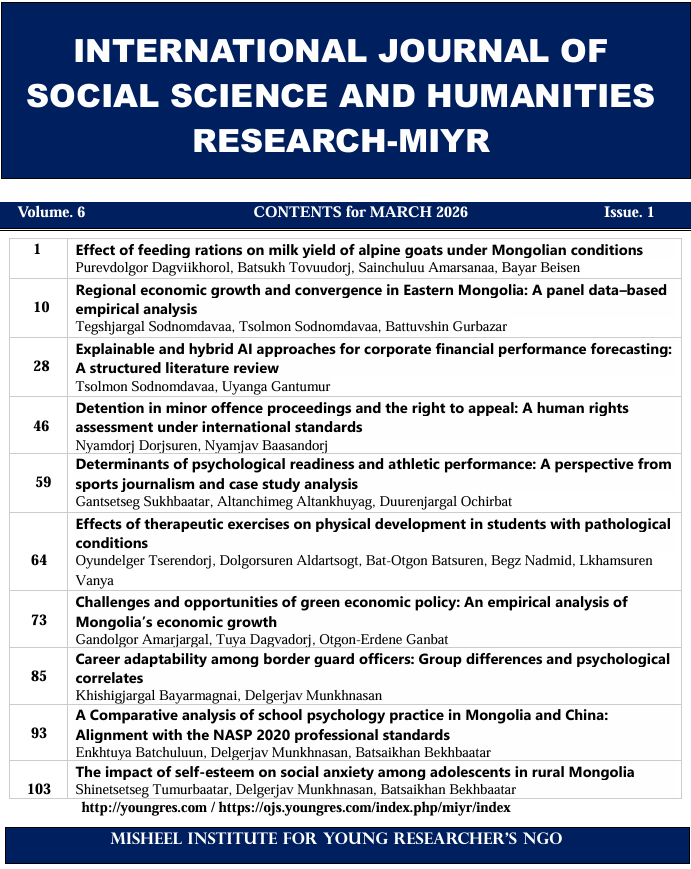
Effect of feeding rations on milk yield of alpine goats under Mongolian conditions
DOI:
https://doi.org/10.53468/mifyr.2026.6.1.1Keywords:
Alpine goat, feeding ration, milk production, feed intake, live weight changeAbstract
This study aimed to develop appropriate feeding rations and norms for dairy Alpine goats under Mongolian conditions and to evaluate their effects on feed chemical composition, feed intake, live weight change, and milk yield. The experiment was conducted from June to September 2021 under barn-feeding conditions at a goat farm in Övörkhangai province, Mongolia. A total of 30 lactating Alpine goats were randomly assigned to one control group and four experimental groups, each receiving different feeding rations. During the experimental period, feed intake, palatability, live weight changes, milk yield, and milk nutritional composition were determined using standard analytical methods. The results showed that goats in the experimental groups had 2.5–3.6% higher feed intake compared to the control group. In addition, live weight increased by 3.6–4.1%, and milk yield improved by 1.6–1.9 times. These findings indicate that an optimized combination of feed ration composition and nutrient balance is a key factor in improving the milk productivity of Alpine goats under Mongolian conditions. Therefore, implementing the developed feeding strategies in production practice could significantly enhance the productivity and efficiency of dairy goat farming, while also supporting domestic milk and dairy production and contributing to the supply of environmentally friendly and safe food products for the population
References
Belanger, J. (1990). Raising milk goats the modern way (Rev. ed.). Storey Publishing.
Jackson, M. (2024). Alpine goats. Independently Published.
Gail, L. (2010). Raising milk goats successfully.
Park, Y. (2017). Goat milk—Chemistry and nutrition.
Indra, R. (2000). Milk and dairy products. Ulaanbaatar.
Tserenkhand, Z., Tumurtogtokh, E., Damdinsuren, D., Bukyei, E., & Buyandelger, E. (2023). Results of studying the fatty acid composition of yak meat of Mongolia. International Journal of Social Science and Humanities Research-MIYR, 3(3), 1–12.
Nayik, G. A., et al. (2021). Recent insights into processing approaches and potential health benefits of goat milk and its products: A review. Frontiers Media S.A. https://pmc.ncbi.nlm.nih.gov/articles/PMC8685332/
Singh, M. K. (2015). Performance of Saanen and Alpine goats under tropical Indian conditions. Indian Journal of Animal Sciences, 85(3), 305–310.
Peacock, C. (2005). Goat production and development in Africa. Small Ruminant Research, 60(1–2), 179–186.
Zhang, Y., Zhao, X., & Li, W. (2013). Crossbreeding between local goats and exotic dairy breeds in China: A review. Livestock Science, 157–164.
McManus, C., Paludo, G. R., Louvandini, H., Gugel, R., Sasaki, L. C. B., & Paiva, S. R. (2009). Heat tolerance in Brazilian sheep: Physiological and blood parameters. Tropical Animal Health and Production, 41(1), 95–101. https://link.springer.com/article/10.1007/s11250-008-9162-1
Haenlein, G. F. W. (2004). Goat milk in human nutrition. Small Ruminant Research, 51(2), 155–163. https://doi.org/10.1016/j.smallrumres.2003.08.010
Ncube, K. T., Modiba, M. C., Mpofu, T. J., Mtileni, B., & Nephawe, K. A. (2024). Genomic tools for medicinal properties of goat’s milk for cosmetic and health benefits: A review. https://www.preprints.org/manuscript/202404.1662/v1
Šalavardić, Ž. K., Potočnik, K., Zvonko, A., & Novoselec, J. (2015). Milk production traits from Alpine breed of goats in Croatia and Slovenia.
Ministry of Food, Agriculture and Light Industry of Mongolia. (n.d.). http://www.mofa.gov.mn
National Statistics Office of Mongolia. (n.d.). http://www.1212.mn
Purevdolgor, D., Khaliunaa, T., & Tumenbayr, K. (2021). Milk yield study of Alpine goats. Mongolian Journal of Agricultural Sciences, 32(1), 21–24.
Bivatec Ltd. (2005). Goat breeds and milk productivity.
Nadmid, N. (2006). Goat husbandry. Ulaanbaatar.
Gendaram, K. (2009). Animal feeding science. Ulaanbaatar.
Mutunga, T., Musalia, L., Gichimu, B., & Migose, S. (2023). Dairy goat production in Kenya: A review.
Hart, S. (2008). Goat nutrition.
Ibrahim, F. A. M., Ahmed, A., & Soliman, S. (2008). Cultivation and evaluation of green forage mixtures for lactating Zaraibi goats. Egyptian Journal of Nutrition and Feeds, 11, 329.
Gerlach, K., Liao, Y., & Südekum, K. (2014). Aerobic exposure of lucerne silages and its impact on preference and dry matter intake by goats. Small Ruminant Research, 308–313.
Maged, G., El-Emam, M. E., El-Kholany, T. H., & El-Sawah, T. H. (2014). Milk production and feed utilization of Zaraibi goats. Journal of Animal and Poultry Production, 5, 815–826.
Ahuya, C., Ojango, J., Mosi, R., & Peacock, C. (2009). Performance of Toggenburg dairy goats. Small Ruminant Research, 7–13.
Sahlu, T., & Goetsch, A. L. (n.d.). Feeding the pregnant and milking doe.
El-Sayed, F. A., & Sadek, W. M. A. (2015). Effect of feeding silage types on goat growth performance. Journal of Animal and Poultry Production, 8, 567.
Gerlach, K., Reimink, A., Messerschmidt, U., & Südekum, K. H. (2017). Ensiled sugar beets in goat diets. Archives of Animal Nutrition, 71(4), 297–310. https://pubmed.ncbi.nlm.nih.gov/28541752/
Gendaram, K., Togtokhbayar, N., & Rinchindorj, D. (2009). Methodology for chemical analysis of feed and meat. Ulaanbaatar.
Tserendulam, R. (1990). Nutritional value chart of feeds. Ulaanbaatar.
Richard, O. (2017). Feed and nutrition of livestock. Ulaanbaatar.
Barbosa, J. G. (2012). Urea levels in feeding Alpine goats. Revista Brasileira de Zootecnia, 41(7). https://doi.org/10.1590/S1516-35982012000700022
Hempstead, M. N., Lindquist, T. M., Shearer, J. K., Shearer, L. C., & Plummer, P. J. (2021). Health and welfare survey of dairy goat farms. Animals, 11(7). https://doi.org/10.3390/ani11072007
Gerlach, K., Roß, F., Weiß, K., Büscher, W., & Südekum, K. H. (2013). Maize silage deterioration effects on goats. Agricultural and Food Science, 22, 168–181.
Zazharska, N., Boyko, O., & Brygadyrenko, V. (2018). Diet influence on goat milk productivity. Indian Journal of Animal Research, 52(5), 711–717.
Goetsch, A. L. (2019). Advances in dairy goat nutrition. Asian-Australasian Journal of Animal Sciences, 32(8), 1296–1305. https://doi.org/10.5713/ajas.19.0485
Hempstead, M. N., Lindquist, T. M., Shearer, J. K., Shearer, L. C., Cave, V. M., & Plummer, P. J. (2021). Welfare assessment of dairy goat farms. Frontiers in Veterinary Science, 8. https://doi.org/10.3389/fvets.2021.646715
Kim, H. J., Kim, J. H., & Lee, H. J. (2016). Comparison of milk composition between Korean native black goats and Alpine goats. Journal of Animal Science and Technology.
Kiptui, B. J., Mewa, E. A., & Kitilit, J. K. (2025). Supplementation effects on milk yield in dairy goats. International Journal of Scientific Research and Science Technology, 12(1), 413–419.
Sadik, W. (2015). Effect of feeding different types of silage on goat growth performance.
Maged, G. A., Sadik, W. M. A., & Mehany, A. A. (2018). Silage mixtures in dairy goat diets.
Monzón-Gil, E., Castañón, J. I. R., & Ventura, M. R. (2010). Low-forage rations and milk production. Small Ruminant Research, 94(1–3), 196–200. https://doi.org/10.1016/j.smallrumres.2010.07.018
Inglingstad, R. A., Næsset, A. L., Randby, T., & Steinshamn, H. (2019). Forage quality effects on goat milk. Journal of Dairy Science, 3, 2345–2354.
Ashry, M. M., Fadel, M. A., Kholif, A. E., & Salem, A. Z. M. (2018). Protein source replacement in goat diets. Egyptian Journal of Nutrition and Feeds, 3, 545–556.
Downloads
Published
How to Cite
Issue
Section
Categories
License
Copyright (c) 2026 Purevdolgor Dagviikhorol, Batsukh Tovuudorj, Sainchuluu Amarsanaa, Bayar Beisen

This work is licensed under a Creative Commons Attribution 4.0 International License.


