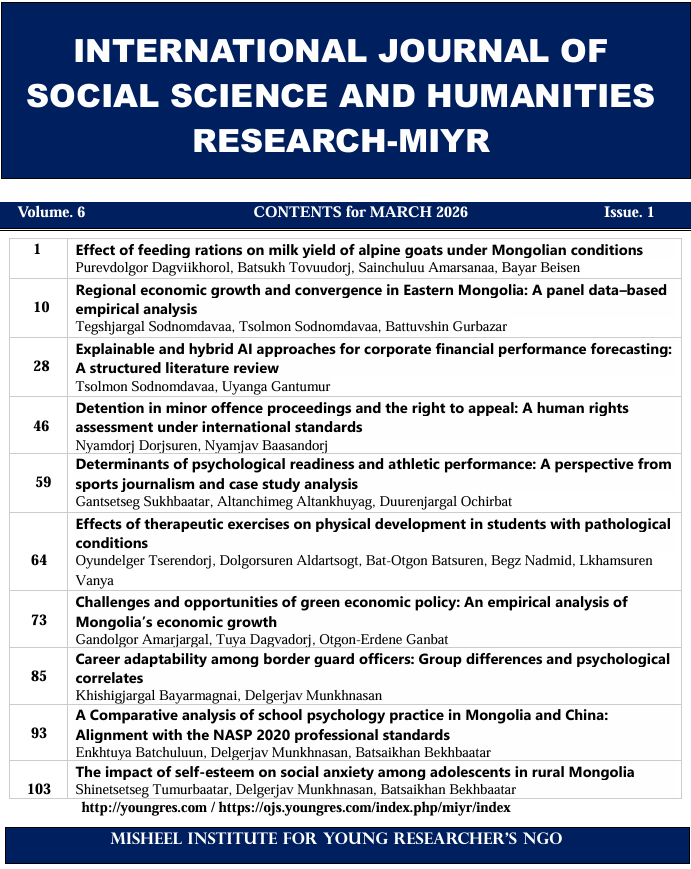
Detention in minor offence proceedings and the right to appeal: A human rights assessment under international standards
DOI:
https://doi.org/10.53468/mifyr.2026.6.1.46Keywords:
Minor offence procedure, Detention sanction, Right to appeal, Fair trial guarantees, Human rights standardsAbstract
This article examines the use of detention sanctions and the effectiveness of the right to appeal in minor offence proceedings in Mongolia from the perspective of international human rights standards. The analysis draws on statistical data, observational findings, and interview evidence from the 24th report of the National Human Rights Commission of Mongolia, complemented by data from judicial and enforcement institutions, as well as comparative insights from Germany, Japan, the United States, and Russia. The findings reveal a significant gap between the formal recognition of the right to appeal and its practical realization. Although appellate review leads to the modification or annulment of a proportion of first-instance decisions, the overall rate of appeals remains extremely low. This indicates that the right to appeal, while legally guaranteed, is not effectively accessible in practice. Key factors limiting its exercise include the widespread use of short-term detention sanctions, restricted access to legal assistance, and insufficient awareness of procedural rights. Comparative analysis demonstrates that international trends increasingly favor limiting custodial sanctions in minor offence proceedings, promoting alternative measures, and strengthening procedural safeguards to ensure effective appellate review. Against this background, the study argues that the current regulatory framework in Mongolia does not adequately secure fair trial guarantees and requires structural reform. In particular, enhancing access to legal assistance, improving procedural safeguards, and reconsidering the use of detention sanctions are essential for ensuring the effective realization of the right to appeal.
References
United Nations. (1966). International covenant on civil and political rights. Office of the United Nations High Commissioner for Human Rights.
Human Rights Committee. (2007). General comment No. 32: Article 14 – Right to equality before courts and tribunals and to a fair trial. United Nations. https://hrlibrary.umn.edu/gencomm/hrcom32.html
United Nations Office on Drugs and Crime. (2013). United Nations principles and guidelines on access to legal aid in criminal justice systems. United Nations. https://www.unodc.org/documents/justice-and prison_reform/UN_principles_and_guidlines_on_access_to_legal_aid.pdf
National Human Rights Commission of Mongolia. (2025). 24th report on the state of human rights and freedoms in Mongolia. Ulaanbaatar, Mongolia.
Judicial General Council of Mongolia. (2025). Annual judicial statistics report of Mongolian courts (2024). Ulaanbaatar, Mongolia.
General Executive Agency of Court Decisions of Mongolia. (2025). Official information letter No. 01/113 from a detention facility under the General Executive Agency of Court Decisions. Ulaanbaatar, Mongolia.
Office of the High Commissioner for Human Rights. (n.d.). Status of ratification: International Covenant on Civil and Political Rights. United Nations Treaty Body Database. https://tbinternet.ohchr.org/_layouts/15/TreatyBodyExternal/Treaty.aspx?Treaty=CCPR
Munkh-Erdene, T. (2016). Comments and recommendations on the draft law on offences and the law on minor offence procedure. Ulaanbaatar, Mongolia.
Nyamdorj, D. (2025). Theoretical foundations of minor offence proceedings. Rule of Law Journal, 104(3), 52.
Federal Ministry of Justice. (n.d.). Act on regulatory offences (Gesetz über Ordnungswidrigkeiten – OWiG). Gesetze im Internet. https://www.gesetze-im-internet.de/englisch_owig/englisch_owig.html
Dulguun, B. (2023). Theoretical issues in distinguishing administrative offences by their characteristics. Ulaanbaatar, Mongolia.
Bayarsaikhan, D. (2011). Comparative criminal law. Ulaanbaatar, Mongolia.
Tonry, M. (2019). Sentencing and sanctions in Western countries. Oxford University Press.
Japan Ministry of Justice. (2020). White paper on crime. Government of Japan.
United Nations Human Rights Committee. (2019). General comment No. 35: Article 9 – Liberty and security of person. United Nations.
Feeley, M. M. (1992). The new penology: Notes on the emerging strategy of corrections and its implications. Criminology, 30(4), 449–474. https://doi.org/10.1111/j.1745-9125.1992.tb01112.x
Council of Europe. (2010). Recommendation CM/Rec(2010)1 of the Committee of Ministers to member states on the Council of Europe probation rules. https://www.coe.int
Downloads
Published
How to Cite
Issue
Section
Categories
License
Copyright (c) 2026 Nyamdorj Dorjsuren, Nyamjav Baasandorj

This work is licensed under a Creative Commons Attribution 4.0 International License.


