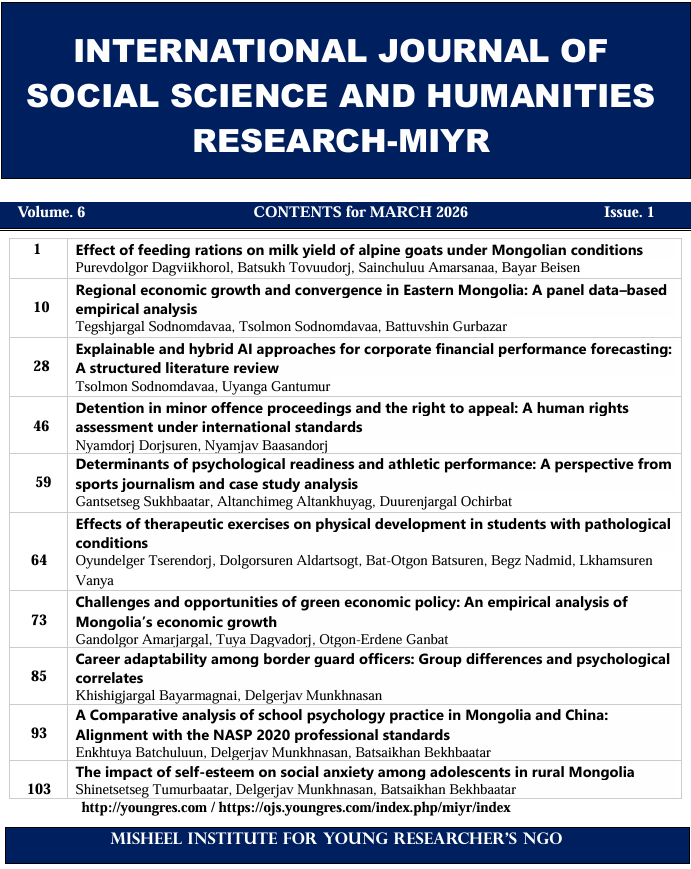
Explainable and hybrid AI approaches for corporate financial performance forecasting: A structured literature review
DOI:
https://doi.org/10.53468/mifyr.2026.6.1.28Keywords:
Corporate financial performance, Hybrid artificial intelligence, Explainable artificial intelligence, Machine learning, ForecastingAbstract
Research on forecasting corporate financial performance has shifted from traditional econometric models toward machine learning, deep learning, and high-precision hybrid AI architectures. These methods can capture nonlinear relationships, high-dimensional structures, and regime shifts in financial data more effectively, which has driven their widespread adoption. At the same time, practical requirements for interpretability, regulatory transparency, and model risk governance have made explainable AI an essential component of modern forecasting systems. This Structured Literature Review synthesizes ninety-three empirical studies published between 2000 and 2025 using a PRISMA-informed selection procedure. It evaluates the actual contributions of hybrid AI and explainable AI to corporate financial performance forecasting. The review shows that econometric and machine learning hybrids, ensemble learning models, DEA-based machine learning frameworks, deep learning combined with signal processing, and multimodal architectures are extensively used and collectively improve predictive accuracy and stability. Methods such as SHAP, LIME, partial dependence, and individual conditional effect analyses, attention mechanisms, and counterfactual reasoning significantly enhance model interpretability, support managerial decision-making, and strengthen compliance with regulatory expectations. Despite these advances, challenges remain, including the predominance of static data analysis, limited generalizability, and the lack of architectures designed for realistic deployment. Future research should focus on multimodal data integration, causal AI, adaptive, real-time learning frameworks, and explainable hybrid systems aligned with regulatory and governance requirements.
References
Emrouznejad, A., & Yang, G. (2022). Hybrid DEA–machine learning approach to forecast efficiency and financial performance. Omega, 112, 102676. https://doi.org/10.1016/j.omega.2022.102676
Liu, H. (2021). Performance prediction using deep learning. Wireless Communications and Mobile Computing, 2021, 1682163. https://doi.org/10.1155/2021/1682163
Martyushev, N. V., Pantiukhina, O. V., & Suvorova, A. V. (2025). Predicting firm performance using hybrid methods. Mathematics, 13(8), 1247. https://doi.org/10.3390/math13081247
Kliestik, T., Vrbka, J., & Rowland, Z. (2022). Forecasting corporate performance using machine learning ensembles. Journal of Business Economics and Management, 23(1), 72–89. https://doi.org/10.3846/jbem.2022.16018
Dong, B., Wang, X., & Cao, Q. (2022). Performance prediction of listed companies in smart healthcare industry based on machine learning algorithms. Journal of Healthcare Engineering, 2022, 8091383. https://doi.org/10.1155/2022/8091383
Xu, Y., Li, S., & Zhang, H. (2024). Predicting firm performance using heterogeneous information and ML. Knowledge-Based Systems, 297, 111352. https://doi.org/10.1016/j.knosys.2023.111352
Zhang, Z., Xiao, Y., & Niu, H. (2022). DEA and machine learning for performance prediction. Mathematics, 10(10), 1776. https://doi.org/10.3390/math10101776
Zhu, N., Zhu, C., & Emrouznejad, A. (2021). ML + DEA for efficiency prediction. Journal of Management Science and Engineering, 6(4), 435–448. https://doi.org/10.1016/j.jmse.2020.10.001
Zhang, D., Chen, Y., & Li, J. (2020). A regime-aware hybrid ML model for asset allocation. Neurocomputing, 415, 295–309. https://doi.org/10.1016/j.neucom.2020.07.017
Che, S., Zhu, W., & Li, X. (2020). Anticipating corporate financial performance from CEO letters utilizing sentiment analysis. Mathematical Problems in Engineering, 2020, 5609272. https://doi.org/10.1155/2020/5609272
Gupta, A., Rawte, V., & Zaki, M. J. (2023). Predicting firm financial performance from SEC filing changes using automatically generated dictionary. Computational Economics, 64(1), 307–334. https://doi.org/10.1007/s10614-023-10443-x
Le, T. D. B., Ngo, M. M., Tran, L. K., & Duong, V. N. (2021). Applying LSTM to predict firm performance based on annual reports. In Data Science for Financial Econometrics (pp. 273–289). https://doi.org/10.1007/978-3-030-87010-8_16
Lam, M. (2004). Neural network techniques for financial performance prediction. Decision Support Systems, 37(4), 567–581. https://doi.org/10.1016/S0167-9236(03)00088-5
Cavalcante, R. C., Brasileiro, R. C., Souza, V. L. F., Nóbrega, J. P., & Oliveira, A. L. I. (2010). Using boosting for financial analysis and performance prediction. Computational Economics, 36(2), 133–151. https://doi.org/10.1007/s10614-010-9205-3
Ma, Y., Han, R., & Wang, W. (2023). Portfolio optimization with explainable DL. Expert Systems with Applications, 213, 118987. https://doi.org/10.1016/j.eswa.2022.118987
Du, J., & Kim, S. (2023). Machine learning–based corporate performance forecasting using multi-source firm information. Omega, 119, 102903. https://doi.org/10.1016/j.omega.2023.102903
Jabeur, S. B., & Lachuer, H. (2023). Corporate financial performance modeling using explainable AI. Journal of Business Research, 159, 113760. https://doi.org/10.1016/j.jbusres.2023.113760
Delen, D., & Kuzey, C. (2023). Corporate value prediction with explainable machine learning. Decision Support Systems, 162, 113518. https://doi.org/10.1016/j.dss.2022.113518
Silva, P., Alves, A., & Ribeiro, B. (2021). Interpretable ML models for corporate performance prediction. Decision Support Systems, 149, 113608. https://doi.org/10.1016/j.dss.2021.113608
Mousa, G. A., Elamir, E. A., & Hussainey, K. (2022). Using ML to predict financial performance: Does disclosure tone matter? International Journal of Disclosure and Governance, 19(1), 93–112. https://doi.org/10.1057/s41310-021-00129-1
Bae, S. C., & Kim, D. (2022). Predicting corporate profitability using machine learning with feature engineering. Decision Support Systems, 154, 113719. https://doi.org/10.1016/j.dss.2021.113719
Lee, J., Jang, D., & Park, S. (2017). Deep learning-based corporate performance prediction. Sustainability, 9(6), 899. https://doi.org/10.3390/su9060899
Malakar, S., & Chakraborty, S. (2024). Interpretable ML for predicting corporate performance. Expert Systems with Applications, 244, 122891. https://doi.org/10.1016/j.eswa.2023.122891
Yuan, M., & Zhang, Y. (2020). Interpretable volatility forecasting using ML. International Journal of Forecasting, 36(4), 1478–1490. https://doi.org/10.1016/j.ijforecast.2020.01.008
Salleh, N., Ramasamy, S., Kamarudin, N., & Hashim, S. (2023). Corporate financial performance prediction using hybrid DL models. Applied Soft Computing, 148, 110810. https://doi.org/10.1016/j.asoc.2023.110810
Papadimitriou, T., Gogas, P., & Papathanasiou, S. (2023). Machine learning for firm value forecasting: An explainable framework. Finance Research Letters, 56, 103659. https://doi.org/10.1016/j.frl.2023.103659
Xie, C., Rajan, D., & Quek, C. (2021). Interpretable neural fuzzy network for stock prediction. Information Sciences, 577, 324–335. https://doi.org/10.1016/j.ins.2021.06.076
Krauss, C., Hansen, M., & Do, X. A. (2023). Forecasting firm fundamentals using deep learning. European Journal of Operational Research, 310(1), 350–366. https://doi.org/10.1016/j.ejor.2023.01.040
Hajek, P., Olej, V., & Myskova, R. (2014). Forecasting corporate financial performance using sentiment in annual reports. Technological and Economic Development of Economy, 20(4), 721–738. https://doi.org/10.3846/20294913.2014.979456
Lin, Y., Luo, H., Wang, Z., & Li, Q. (2023). ESG factors and corporate financial performance prediction using interpretable ML. Journal of Cleaner Production, 413, 137574. https://doi.org/10.1016/j.jclepro.2023.137574
Giudici, P., & Raffinetti, E. (2022). Explainable AI methods in cyber risk management. Quality and Reliability Engineering International, 38(3), 1318–1326. https://doi.org/10.1002/qre.2992
Bahrami, M., Boz, H. A., Suhara, Y., Balcısoy, S., Bozkaya, B., & Pentland, A. (2023). Predicting merchant future performance using privacy-safe network-based features. Scientific Reports, 13, 10073. https://doi.org/10.1038/s41598-023-36624-0
Vuković, D. B., Spitsina, L., Gribanova, E., Spitsin, V., & Lyzin, I. (2023). Predicting the performance of retail market firms. Mathematics, 11(8), 1916. https://doi.org/10.3390/math11081916
Zahariev, A., Angelov, P., & Zarkova, S. (2022). Estimation of bank profitability using ML. Economic Alternatives, 2, 157–170. https://doi.org/10.37075/EA.2022.2.09
Weng, F., Zhu, J., Yang, C., Gao, W., & Zhang, H. (2022). Financial pressure impacts with explainable ML. Expert Systems with Applications, 210, 118482. https://doi.org/10.1016/j.eswa.2022.118482
Rallis, I., Markoulidakis, Y., Georgoulas, I., & colleagues. (2022). Interpretation of NPS attributes. Pervasive Technologies Related to Assistive Environments, 113–117. https://doi.org/10.1145/3529190.3529205
Attanasio, G., Cagliero, L., & Baralis, E. (2020). Leveraging the explainability of associative classifiers to support quantitative stock trading. In Proceedings of the International Workshop on Data Science for Macro-Modeling (pp. 1–6). https://doi.org/10.1145/3401832.3402679
Downloads
Published
How to Cite
Issue
Section
Categories
License
Copyright (c) 2026 Tsolmon Sodnomdavaa, Uyanga Gantumur

This work is licensed under a Creative Commons Attribution 4.0 International License.


