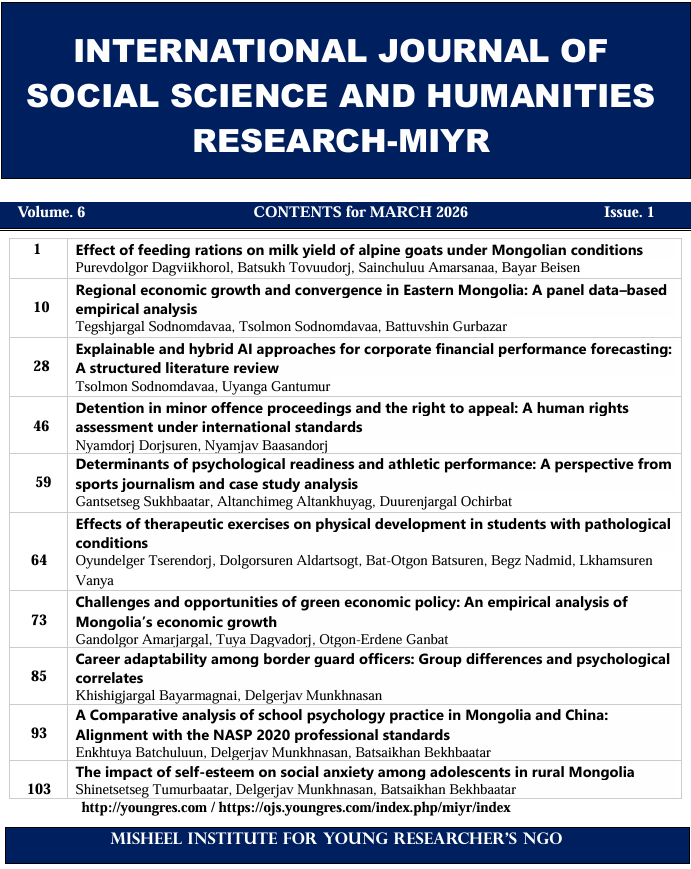
Regional economic growth and convergence in Eastern Mongolia: A panel data–based empirical analysis
DOI:
https://doi.org/10.53468/mifyr.2026.6.1.10Keywords:
Regional economic growth, β-convergence, human capital, spatial spillover effects, panel dataAbstract
Uneven regional economic growth and persistent income disparities remain major challenges for sustainable development in many developing economies. These issues are particularly evident in resource-dependent countries with concentrated sectoral structures, where the benefits of economic expansion are unevenly distributed across regions. This study examines regional economic growth, income convergence, and interregional spillover effects in Mongolia’s eastern provinces using panel data from 2000 to 2024. The empirical analysis estimates both absolute and conditional β-convergence models using panel regression techniques. In addition, the study investigates spillover effects to assess how economic growth in the eastern region is interconnected with economic dynamics in other regions of Mongolia. The econometric framework incorporates key determinants of regional growth, including human capital development, industrial structure, financial conditions, and settlement characteristics. The results provide evidence of both absolute and conditional β-convergence within the eastern region, indicating that provinces with lower initial income levels tend to grow faster. However, convergence dynamics appear to be influenced more strongly by national macroeconomic conditions and sectoral cycles than by province-specific characteristics. Human development and industrial activity positively affect regional growth, whereas financial pressures, educational constraints, and weaknesses in settlement structures limit growth performance. The findings highlight the importance of targeted regional policies that strengthen human capital, support economic diversification, and account for spatial interdependencies across regions.
References
Capello, R., Caragliu, A., & Fratesi, U. (2015). Spatial heterogeneity in the costs of the economic crisis in Europe: are cities sources of regional resilience? Journal of Economic Geography, 15(5), 951–972. https://doi.org/10.1093/jeg/lbu053
Venables, A. J. (2016). Using Natural Resources for Development: Why Has It Proven So Difficult? Journal of Economic Perspectives, 30(1), 161–184. https://doi.org/10.1257/jep.30.1.161
Boschma, R. (2016). Relatedness as driver of regional diversification: a research agenda. Regional Studies, 51(3), 351–364. https://doi.org/10.1080/00343404.2016.1254767
Faggian, A., & McCann, P. (n.d.). Human Capital and Regional Development. Handbook of Regional Growth and Development Theories. https://doi.org/10.4337/9781848445987.00015
Martin, R., & Sunley, P. (2014). On the notion of regional economic resilience: conceptualization and explanation. Journal of Economic Geography, 15(1), 1–42. https://doi.org/10.1093/jeg/lbu015
Solow, R. M. (1956). A contribution to the theory of economic growth. The Quarterly Journal of Economics, 70(1), 65–94. https://doi.org/10.2307/1884513
Barro, R. J. (1992). Convergence. Journal of Political Economy, 100(2), 223–251. https://doi.org/10.1086/261816
Barro, R. J., & Sala-i-Martin, X. (2004). Economic growth (2nd ed.). MIT Press.
Mankiw, N. G., Romer, D., & Weil, D. N. (1992). A Contribution to the Empirics of Economic Growth. The Quarterly Journal of Economics, 107(2), 407–437. https://doi.org/10.2307/2118477
Islam, N. (1995). Growth Empirics: A Panel Data Approach. The Quarterly Journal of Economics, 110(4), 1127–1170. https://doi.org/10.2307/2946651
Lucas, R. E. (1988). On the mechanics of economic development. Journal of Monetary Economics, 22(1), 3–42. https://doi.org/10.1016/0304-3932(88)90168-7
Benhabib, J., & Spiegel, M. M. (1994). The role of human capital in economic development evidence from aggregate cross-country data. Journal of Monetary Economics, 34(2), 143–173. https://doi.org/10.1016/0304-3932(94)90047-7
Barro, R. J. (1991). Economic Growth in a Cross Section of Countries. The Quarterly Journal of Economics, 106(2), 407. https://doi.org/10.2307/2937943
Dansranbavuu, L., Natsagdorj, B., Tsolmon, S., Nasanjargal, P., Scott, P. H., & Ts, E. (2017). Contribution of agriculture to economic growth in Mongolia. Mongolia. 1 (2). https://doi.org/10.22662/ijemr.2017.1.2.023
Sachs, J. D., & Warner, A. M. (2001). The curse of natural resources. European Economic Review, 45(4–6), 827–838. https://doi.org/10.1016/s0014-2921(01)00125-8
Cecchetti, S. G., Mohanty, M. S., & Zampolli, F. (2011). The real effects of debt (BIS Working Papers No. 352). Bank for International Settlements. https://www.bis.org/publ/work352.pdf
Krugman, P. (1991). Increasing Returns and Economic Geography. Journal of Political Economy, 99(3), 483–499. https://doi.org/10.1086/261763
LeSage, J., & Pace, R. K. (2009). Introduction to Spatial Econometrics. Chapman and Hall/CRC. https://doi.org/10.1201/9781420064254
Crespo Cuaresma, J., & Piribauer, P. (2015). Bayesian Variable Selection in Spatial Autoregressive Models. WU Vienna University of Economics and Business. Department of Economics Working Paper Series No. 199 https://doi.org/10.57938/aa3effd2-1312-4f27-bee3-5e8e74f45f99
Shaban, A. (2024). Regional Economic Growth Spillover in India. Spatial Spillovers, 153–170. https://doi.org/10.1007/978-981-97-4901-0_7
Buyukyazici, D. (2024). Digital skills and industrial diversification of regions. Regional Studies, Regional Science, 11(1), 583–598. https://doi.org/10.1080/21681376.2024.2388075
Balado-Naves, R., Baños-Pino, J. F., & Mayor, M. (2023). Spatial spillovers and world energy intensity convergence. Energy Economics, 124, 106807. https://doi.org/10.1016/j.eneco.2023.106807
Ren, X., Yang, W., & Jin, Y. (2024). Geopolitical risk and renewable energy consumption: Evidence from a spatial convergence perspective. Energy Economics, 131, 107384. https://doi.org/10.1016/j.eneco.2024.107384
Gao, S., Zhou, P., & Zhang, H. (2023). Does energy transition help narrow the urban-rural income gap? Evidence from China. Energy Policy, 182, 113759. https://doi.org/10.1016/j.enpol.2023.113759
Sodnomdavaa, T., Sodnomdavaa, T., Gurbazar, B., & Amarjargal, E. (2025). An Augmented Gravity Model Analysis of Air Travel Demand in Emerging Tourism Destinations. International Journal of Social Science and Humanities Research-MIYR, 5(3), 31–42. https://doi.org/10.53468/ijsshr-miyr.v5i3.4
Downloads
Published
How to Cite
Issue
Section
Categories
License
Copyright (c) 2026 Tegshjargal Sodnomdavaa, Tsolmon Sodnomdavaa, Battuvshin Gurbazar

This work is licensed under a Creative Commons Attribution 4.0 International License.


