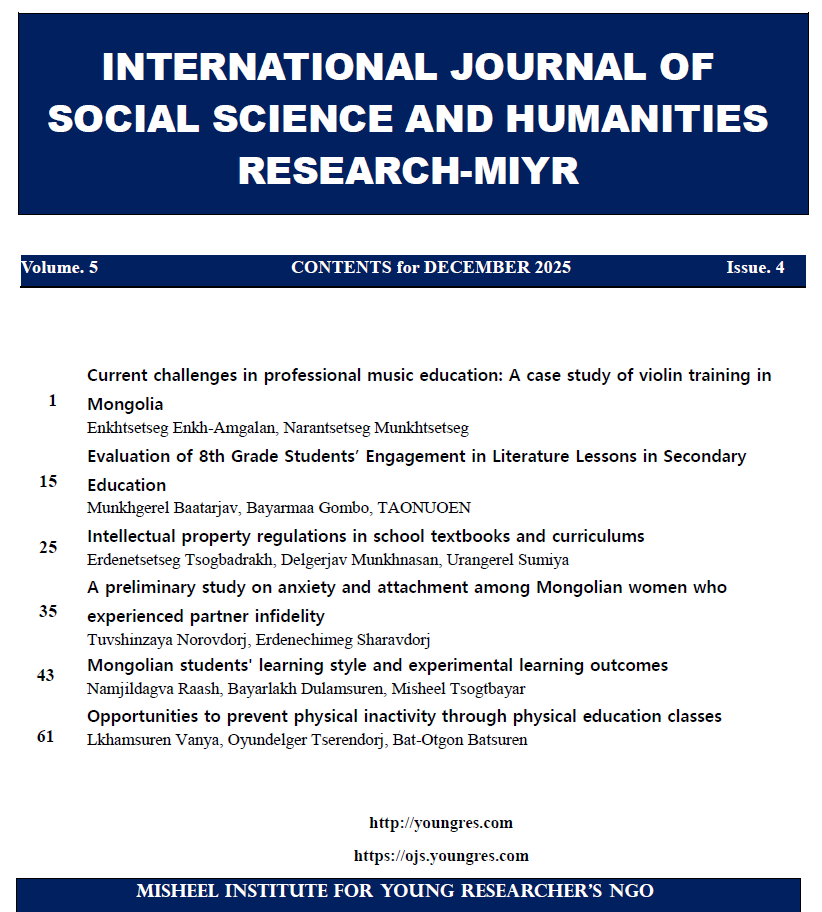
Mongolian students' learning style and experimental learning outcomes
DOI:
https://doi.org/10.53468/mifyr.2025.5.4.43Keywords:
Deferent learning styles, Experiential learning approach, Learning outcomesAbstract
Contemporary educational culture increasingly expects instructors to design instructional practices that accommodate diverse learning styles while conducting fair and unbiased assessments of students’ learning progress. In response to these expectations, the present study aimed to identify the learning styles of Mongolian university students using standardized measurement instruments and to examine learning outcomes through the implementation of teaching methodologies aligned with these styles. Accordingly, this study compares different learning style preferences and examines their interrelationships. The learning styles of 986 undergraduate students (47% male) from the Mongolian National University of Education (MNUE) and the Mongolian University of Science and Technology (MUST) were assessed using the internationally recognized Felder–Solomon Index of Learning Styles (ILS). The ILS instrument was selected due to its wide application in higher education research and its relevance to instructional design. Furthermore, the dimensions of learning and teaching styles proposed by R. M. Felder were employed to design an experimental instructional intervention. Based on the results of a pilot study conducted among students at MNUE, appropriate instructional methods were selected and organized in alignment with identified learning style distributions. In addition, a training strategy was developed by integrating principles derived from traditional Mongolian science, particularly the central view emphasizing physical, linguistic, and mental purity, alongside organizational principles drawn from management science. The experimental implementation involved 65 second-year undergraduate students majoring in Learning and Teaching at the School of Social Sciences. The instructional strategy was applied over the experimental period, and students’ learning outcomes were evaluated using pre- and post-intervention assessments. Statistical analysis revealed a significant difference between pre-test and post-test learning outcomes (p = 0.000), with mean scores increasing from 78.78 to 91.68, respectively. Moreover, a strong positive correlation was observed between the overall pre- and post-test assessments (R = 0.825). These results indicate that the instructional intervention, designed in accordance with students’ learning styles and culturally grounded pedagogical principles, contributed to a statistically significant improvement in learning outcomes, suggesting the effectiveness of the proposed training approach.
References
Namjildagva, R. (2025). Analysis and results of the application of the quantum approach to education created by Mongolians (Doctoral dissertation). Mongolian National University of Education.
Kolb, D. A. (1984). Experiential learning: Experience as the source of learning and development (Vol. 1). Prentice Hall.
Felder, R. M. (1993). Reaching the second tier. Journal of College Science Teaching, 23(5), 286–290.
Felder, R. M., & Henriques, E. R. (1995). Learning and teaching styles in foreign and second language education. Foreign Language Annals, 28, 21–31. doi.org/10.1111/j.1944-9720.1995.tb00767.x
James, W. B., & Gardner, D. L. (1995). Learning styles: Implications for distance learning. New Directions for Adult and Continuing Education, 1995, 19–31.
Kluckhohn, C., & Murray, H. A. (1953). Personality in nature, society, and culture. New York, NY: Alfred A. Knopf.
Curry, L., & Adams, C. (1991). Patterns of learning style across selected medical specialties. Educational Psychology, 11(3–4), 247–277. doi.org/10.1080/0144341910110304
Nugraha, I., & Eliyawati. (2019). The use of video laboratory report to develop presentation skills in science teacher education students. Journal of Physics: Conference Series, 1157(2), 1–6
Fleming, N. D., & Mills, C. (1992). Helping students understand how they learn. The Teaching Professor, 7(4), 44–63.
Gouinlock, J. S. (2023). John Dewey. In Encyclopaedia Britannica.
Gerig, R. J. (1993). Experiencing narrative worlds: On the psychological activities of reading. Yale University Press.
Gernsbacher, M. A., & Hargreaves, D. J. (1988). Accessing sentence participants: The advantage of first mention. Journal of Memory and Language, 27(6), 699–717.
Bransford, J. D., & Johnson, M. K. (1972). Contextual prerequisites for understanding: Some investigations of comprehension and recall. Journal of Verbal Learning and Verbal Behavior, 11(6), 717–726.
Kendeou, P., Rapp, D. N., & van den Broek, P. (2003). The influence of reader’s prior knowledge on text comprehension and learning from text. Progress in Education, 13, 189–208.
Felder, R. M., & Soloman, B. A. (2000). Learning styles and strategies. North Carolina State University.
Felder, R. M., & Silverman, L. K. (1988). Learning and teaching styles in engineering education. Engineering Education, 78(7), 674–681.
Felder, R. M., & Spurlin, J. (2005). Applications, reliability, and validity of the Index of Learning Styles. International Journal of Engineering Education, 21(1), 103–112.
Felder, R. M., & Brent, R. (2016). Teaching and learning STEM: A practical guide. Jossey-Bass.
Namjildagva, R., & Tumentsetseg, B. (2020). A study of Mongolian teacher training school students’ learning styles using the Felder–Soloman Index of Learning Styles (ILS). Leena and Luna International, 9(3), 73–86.
Felder, R. M., & Silverman, L. K. (1988). Learning and teaching styles in engineering education. Engineering Education, 78(7), 674–681.
Graf, S., Liu, T.-C., Kinshuk, Chen, N.-S., & Yang, S. J. H. (2010). Learning styles and cognitive traits: Their relationship and its benefits in web-based educational systems. Computers in Human Behavior, 26(6), 1280–1289. doi.org/10.1016/j.chb.2010.03.005
Gülbahar, Y., & Alper, A. (2011). Learning styles and preferences in distance education. The International Review of Research in Open and Distributed Learning, 12(4), 148–168. https://doi.org/10.19173/irrodl.v12i4.919
Kolekar, S. V., Pai, R. M., & Pai, M. M. M. (2018). Prediction of learner’s profile based on learning styles in adaptive e-learning system. International Journal of Emerging Technologies in Learning, 13(2), 146–162.
Pitigala Liyanage, M. P., Gunawardena, K. S. L., & Hirakawa, M. (2014). Using learning styles to enhance learning management systems. International Journal on Advances in ICT for Emerging Regions, 7(2), 1–10. doi.org/10.4038/icter.v7i2.7153
Wang, J., & Mendori, T. (2015). A study of the reliability and validity of the Felder–Soloman Index of Learning Styles in Mandarin version. In Proceedings of the 2015 IIAI 4th International Congress on Advanced Applied Informatics (pp. 370–373). doi.org/10.1109/IIAI-AAI.2015.284
Grzybowski, D. M., & Demel, J. T. (2015). Assessment of inverted classroom success based on Felder’s Index of Learning Styles. In Proceedings of the 122nd American Society for Engineering Education Annual Conference & Exposition. American Society for Engineering Education.
Lee, S. H., Wise, J., Litzinger, T., & Felder, R. M. (2005, June). A study of the reliability and validity of the Felder–Soloman Index of Learning Styles. In Proceedings of the 2005 Annual Conference & Exposition of the American Society for Engineering Education. doi.org/10.18260/1-2-15321
Metallidou, P., & Platsidou, M. (2008). Kolb’s Learning Style Inventory-1985: Validity issues and relations with metacognitive knowledge about problem-solving strategies. Learning and Individual Differences, 18(1), 114–119. doi.org/10.1016/j.lindif.2007.11.001
Van Zwanenberg, N., Wilkinson, L. J., & Anderson, A. (2000). Felder and Silverman’s Index of Learning Styles and Honey and Mumford’s Learning Styles Questionnaire: How do they compare and do they predict academic performance? Educational Psychology, 20(3), 365–380. doi.org/10.1080/713663743
Wong, G. K. W., & Cheung, H.-Y. (2020). Exploring children’s perceptions of developing twenty-first century skills through computational thinking and programming. Interactive Learning Environments, 28(4), 438–450. doi.org/10.1080/10494820.2018.1534245
Zywno, M. S. (2003, June). A contribution to validation of score meaning for Felder–Soloman’s Index of Learning Styles. In Proceedings of the 2003 American Society for Engineering Education Annual Conference & Exposition. doi.org/10.18260/1-2-12424
Jadamba, B., Purev-Ochir, B., Erdenechuluun, D., Myagmar, O., Tuya, B., & Ichinkhorloo, S. (2014). A study of the mental, physical, social and ethnic characteristics of Mongolian children (Project Report No. 201100123). MUBIS Press.
Shi, H., Raash, N., Baatarjav, M., & Narantsetseg, M. (2024). Comparative analysis of intellectual abilities differences of Mongolian and Chinese students. International Journal of Social Science and Humanities Research-MIYR, 4(2). doi.org/10.53468/mifyr.2024.04.02.15
Downloads
Published
How to Cite
Issue
Section
Categories
License
Copyright (c) 2026 Namjildagva Raash, Bayarlakh Dulamsuren, Misheel Tsogtbayar

This work is licensed under a Creative Commons Attribution 4.0 International License.


