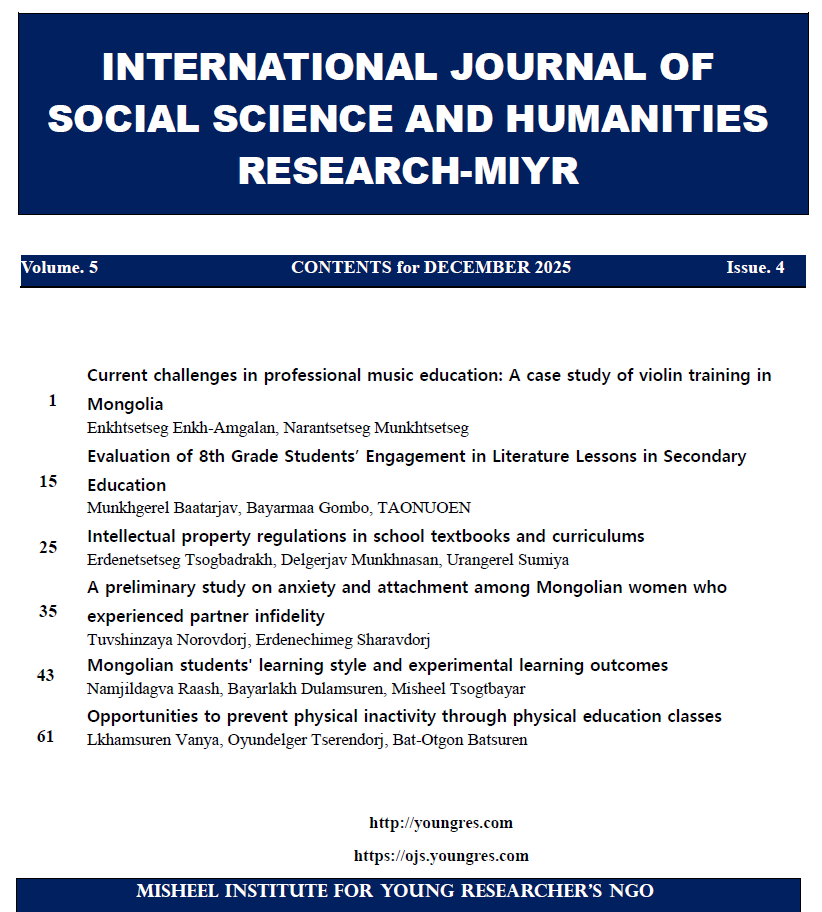
A preliminary study on anxiety and attachment among Mongolian women who experienced partner infidelity
DOI:
https://doi.org/10.53468/mifyr.2025.5.4.35Keywords:
Extramarital infidelity, Anxiety, Attachment style, Trait anxiety, State anxiety, Mongolian womenAbstract
According to the 2024 Statistical Bulletin of the National Statistics Office of Mongolia (NSO, 2024), a total of 4,463 divorces were recorded nationwide. One of the primary causes of marital dissolution is infidelity. For Mongolian women, the psychological state after being exposed to infidelity is not so obvious, but rather hidden, because it is directly related to social expectations and values. After the betrayal of trust, women experience many negative consequences, including decreased self-esteem, social isolation, loss of security, difficulty controlling negative emotions, fear of losing again, and increased internal family conflict. Many studies conducted abroad have shown that women who have been involved in infidelity experience a lot of anxiety. Within this study, a sample of 30 married women aged 26 to 55 residing in Ulaanbaatar was selected. The purpose of this study is to examine the relationship between anxiety levels and attachment styles among women who have experienced extramarital betrayal. The research employed the State-Trait Anxiety Inventory and a general demographic questionnaire to collect data. The findings revealed that women who had experienced infidelity exhibited higher levels of anxiety compared to the normative population. Preliminary findings also suggest that attachment styles may be associated with variations in anxiety levels among women affected by partner infidelity. Attachment styles showed limited but notable variation in anxiety levels, suggesting the need for further investigation with larger samples.
References
Rokach, A., & Chan, S. H. (2023). Love and infidelity: Causes and consequences. International journal of environmental research and public health, 20(5), 3904. doi.org/10.3390/ijerph20053904
Freyd, J., & Birrell, P. (2013). Blind to betrayal: Why we fool ourselves we aren't being fooled. Turner Publishing Company.
Zhang, N., Parish, W. L., Huang, Y., & Pan, S. (2012). Sexual infidelity in China: Prevalence and gender-specific correlates. Archives of Sexual Behavior, 41(4), 861-873. https://link.springer.com/article/10.1007/s10508-012-9930-x
Narantuya, J. (2020), “Psychological reactions of women following betrayal,” Master’s thesis, National University of Mongolia, Ulaanbaatar.
Uuganbayar, B.(2018), “The relationship between marital trust and relationship satisfaction,” Master’s thesis, National University of Mongolia.
Batsaikhan, Ts. & B. Delgerjav, (2013), Setgel sudlalyn undes. Ulaanbaatar: MUBIS Press.
Freyd, J. J.(1994) Betrayal trauma: Trauma, memory, and awareness, Journal Trauma. Stress, 7(4), 525–548. https://www.hup.harvard.edu/books/9780674068063
Altschul, S. (1984). Attachment and Loss, Vol. 3. Loss, Sadness and Depression. By John Bowlby. Journal of the American Psychoanalytic Association, 32(1), 216-218. doi/abs/10.1177/000306518403200125
Fraley, R. C., Waller, N. G., & Brennan, K. A. (2000). An item response theory analysis of self-report measures of adult attachment. Journal of personality and social psychology, 78(2), 350. doi.org/10.1037/0022-3514.78.2.350
Russell, V. M., Baker, L. R., & McNulty, J. K. (2013). Attachment insecurity and infidelity in marriage: Do studies of dating relationships really inform us about marriage?. Journal of Family Psychology, 27(2), 242. https://psycnet.apa.org/buy/2013-11026-005
Downloads
Published
How to Cite
Issue
Section
Categories
License
Copyright (c) 2026 Tuvshinzaya Norovdorj, Erdenechimeg Sharavdorj

This work is licensed under a Creative Commons Attribution 4.0 International License.


