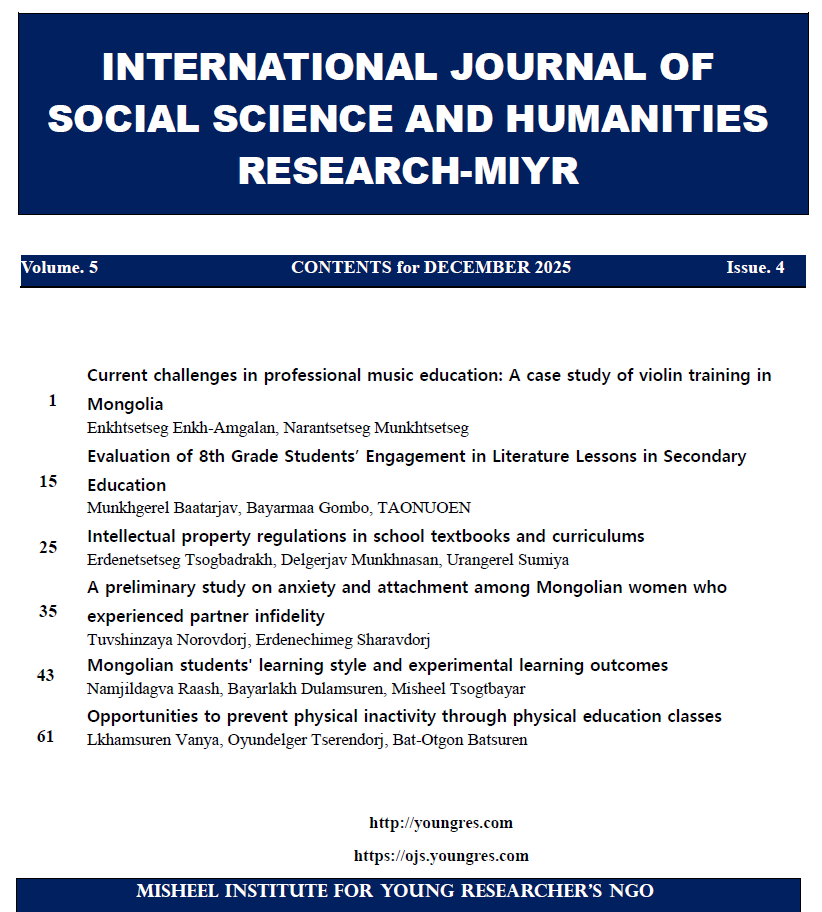
Current challenges in professional music education: A case study of violin training in Mongolia
DOI:
https://doi.org/10.53468/mifyr.2025.5.4.1Keywords:
Violin education. Musculoskeletal Pain. Student dropout. Preventive training. Performing arts Medicine. Communication dynamics. Educational reformAbstract
Professional music training in Mongolia requires early specialization, physical endurance, and strong psychological resilience. Despite this rigorous framework, dropout rates among violin students remain exceptionally high, suggesting deeper health-related and institutional issues. This study investigates the multifactorial reasons for student withdrawal from professional violin programs, focusing on musculoskeletal strain, communication dynamics, family environment, and institutional support structures. Using a mixed-methods design, the study collected quantitative and qualitative data from 35 participants, including 25 former violin students, five parents, and five teachers. Statistical analyses—correlation, t-tests, and regression—were complemented by thematic analysis of interviews and institutional records. Results identified musculoskeletal pain (particularly in the shoulder, neck, and wrist) as the strongest predictor of dropout. Physical discomfort significantly reduced practice consistency and performance confidence. Communication gaps among teachers, parents, and students further delayed recognition of problems, while unstable home environments and limited practice space contributed to declining motivation. Institutional constraints, including insufficient teacher training in injury prevention, lack of preventive health education, and inadequate documentation of withdrawal reasons, further compounded the problem. The study concludes that student dropout is not attributable to lack of talent or commitment but to the accumulation of untreated physical strain, communication breakdowns, and structural limitations. The paper recommends integrating an “Artistic Physical Education” curriculum, improving teacher training in musician health, establishing national standards for musician well-being, enhancing parent engagement, and strengthening institutional documentation systems. These reforms are essential for sustaining Mongolia’s classical music tradition while ensuring the long-term well-being of young violinists
References
Mongolian State Conservatory.(2020). About the school. www.conservatory.edu.mn/about-us/about-school
Schellenberg, E. G. (2004). Music lessons enhance IQ. Psychological Science, 15(8), 511–514. doi.org/10.1111/j.0956-7976.2004.00711.x
Hyde, K. L., Lerch, J., Norton, A., Forgeard, M., Winner, E., Evans, A. C., & Schlaug, G. (2009). Musical training shapes structural brain development. Journal of Neuroscience, 29(10), 3019–3025. doi.org/10.1523/JNEUROSCI.5118-08.2009
Ranelli, S., Straker, L., & Smith, A. (2011). Playing-related musculoskeletal problems in children learning instrumental music. Medical Problems of Performing Artists, 26(3), 123–139. doi.org/10.21091/mppa.2011.3022
Zaza, C. (1998). Playing-related musculoskeletal disorders in musicians: A systematic review. CMAJ, 158(8), 1019–1025. doi.org/10.1503/cmaj.158.8.1019
Ackermann, B. J., Driscoll, T., & Kenny, D. T. (2012). Sound practice for professional musicians. Safe Work Australia.
Mongolian National University of Education. (2022). Music teacher training report: Status of ergonomics education in Mongolian music schools. MNUE Press. www.msue.edu.mn/research/music-education-2022
Wu, S. J. (2002). The effect of culture on the learning styles of Asian international music students. International Education, 32(1), 42–53. doi.org/10.1080/15507020209500271
Mongolian State Conservatory. (2024). Student enrollment and completion statistics: String department. Internal institutional report.
String Department. (2022). Student enrollment and completion statistics. Mongolian State Conservatory.
Rickert, D. L., Barrett, M. S., & Ackermann, B. J. (2015). Injury and the orchestral environment: Part I. Medical Problems of Performing Artists, 30(1), 1–8. doi.org/10.21091/mppa.2015.1001
Matei, R., Broad, S., Goldbart, J., & Ginsborg, J. (2018). The impact of the Alexander Technique on well-being and performance in musicians. Frontiers in Psychology, 9, 1–13. doi.org/10.3389/fpsyg.2018.01137
Kok, L. M., Huisstede, B. M., Voorn, V. M., Schoones, J. W., & Nelissen, R. G. (2016). The occurrence of musculoskeletal complaints among professional musicians: A systematic review. International Archives of Occupational and Environmental Health, 89(3), 373–396. doi.org/10.1007/s00420-015-1090-6
Ministry of Education and Science of Mongolia. (2023). National arts education strategy 2023–2030. Government policy document.
Tumenjargal, T. (2021). Leçons de mécanisme du mouvement appliquées à l’enseignement du violon (Paris, 1884). Art in the 21st Century Youth Conference, Ulaanbaatar.
Fishbein, M., Middlestadt, S. E., Ottati, V., Straus, S., & Ellis, A. (1988). Medical problems among ICSOM musicians: Overview of a national survey. APSArts.
Matei, R., & Ginsborg, J. (2021). Health education for musicians: A systematic review of programs, their content, and impacts. Frontiers in Psychology, 12, 698537. doi.org/10.3389/fpsyg.2021.698537
Steinmetz, A., Scheffer, I., & Münte, T. F. (2022). Prevalence and risk factors of musculoskeletal disorders in musicians: A systematic review and meta-analysis. Journal of Occupational Medicine and Toxicology, 17(1), 15. doi.org/10.1186/s12995-022-00358-6
Spahn, C., Richter, B., & Zschocke, I. (2021). Health status and health behavior of musicians in German professional orchestras. Medical Problems of Performing Artists, 36(2), 87–95. doi.org/10.21091/mppa.2021.2012
Visentin, P., Shan, G., & Doan, J. B. (2022). Neuromuscular control and biomechanical analysis of professional violinists. Journal of Electromyography and Kinesiology, 65, 102689. doi.org/10.1016/j.jelekin.2022.102689
Steinmetz, A., Möller, H., & Seidel, E. J. (2012). Playing-related musculoskeletal disorders in music students. National Library of Medicine, 625–633. pubmed.ncbi.nlm.nih.gov/23138678/
Jabusch, H. C., Müller, S. V., & Altenmüller, E. (2020). Early specialization and practice-related musculoskeletal disorders in young instrumentalists. Journal of Hand Therapy, 33(4), 592–601. doi.org/10.1016/j.jht.2020.03.002
Gembris, H., Menze, J., Heye, A., & Bullerjahn, C. (2020). High-performing young musicians’ playing-related pain. Frontiers in Psychology. doi.org/10.3389/fpsyg.2020.564736
Osborne, M. S., McPherson, G. E., & Williamon, A. (2021). The psychology of music performance anxiety in young musicians. Psychology of Music. doi.org/10.1177/0305735620944232
Hawkes, M. E. (2018). The practical application of psychological skills training for musicians (Doctoral thesis). etheses.whiterose.ac.uk/id/eprint/24062/
Burcal, C. J., Needle, A. R., Custer, L., & Rosen, A. B. (2019). The effects of cognitive loading on motor behavior in injured individuals. Sports Medicine, 49, 1233–1253. doi.org/10.1007/s40279-019-01116-7
Xu, S., & Li, D. (2025). Autonomy-supportive music teaching and students’ well-being. Acta Psychologica, 254, 104827. doi.org/10.1016/j.actpsy.2025.104827
Davies, J. (2020). Alexander Technique classes improve pain and performance factors. Journal of Bodywork and Movement Therapies, 24(1), 1–7. doi.org/10.1016/j.jbmt.2019.04.006
Davies, J. (2020). Alexander Technique classes improve pain and performance factors. Journal of Bodywork and Movement Therapies, 24(1), 1–7. doi.org/10.1016/j.jbmt.2019.04.006
Matheve, A., De Baets, S., & Timmermans, A. (2020). Integrating somatic practices in higher music education. Research Studies in Music Education, 42(1), 45–62. doi.org/10.1177/1321103X20923745
Perkins, R., Reid, H., Araújo, L. S., Clark, T., & Williamon, A. (2017). Performing at the top of one’s game. Frontiers in Psychology, 8, 1352. doi.org/10.3389/fpsyg.2017.01352
Bat-Erdene, R. (2020). Cultural barriers to musician health education in post-socialist Mongolia. Music Education Research. doi.org/10.1080/14613808.2020.1847632
Perkins, R., Williamon, A., & Ginsborg, J. (2021). The hidden curriculum of pain. Music Education Research. doi.org/10.1080/14613808.2021.1929140
Williamon, A., & Perkins, R. (2022). A global comparison of health and wellness provision in conservatoires. In The musician’s body: A maintenance manual. 45–62. doi.org/10.4324/9781003249264-5
Suvd, T., Namsraijav, M., Sukhbayar, B., & Erdenebileg, G.-O. (2024). Culturally responsive school leadership and education for sustainable development. International Journal of Social Science and Humanities Research, 4(1), 51–63. doi.org/10.53468/mifyr.2024.04.01.51
Downloads
Published
How to Cite
Issue
Section
Categories
License
Copyright (c) 2025 Enkhtsetseg Enkh-Amgalan, Narantsetseg Munkhtsetseg

This work is licensed under a Creative Commons Attribution 4.0 International License.


