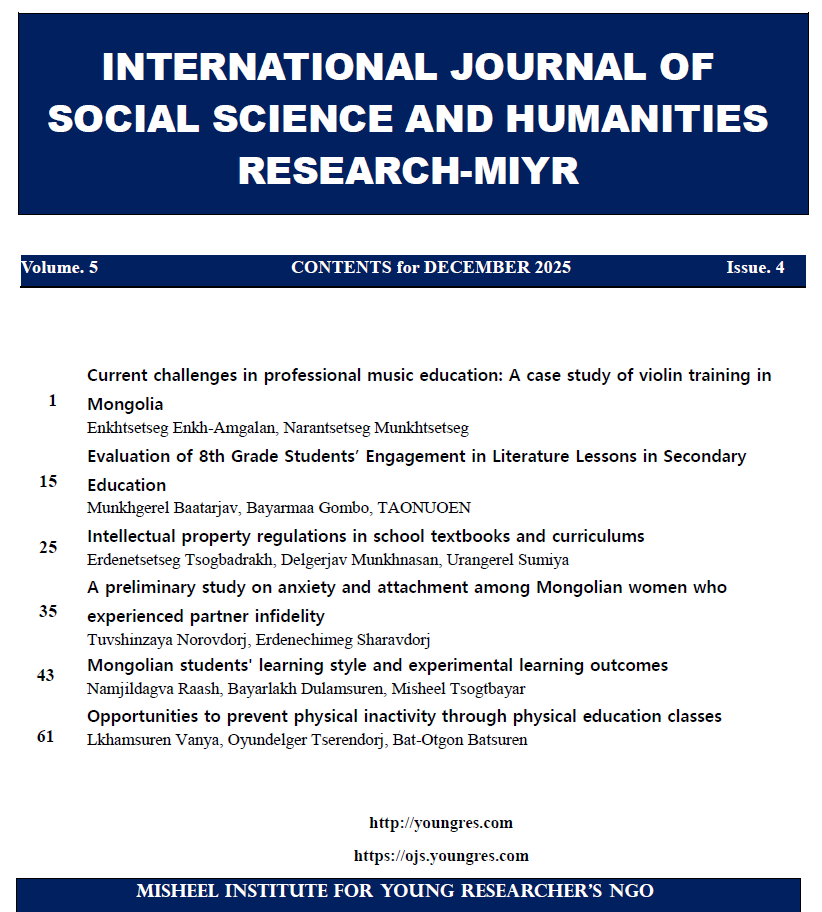
Intellectual property regulations in school textbooks and curriculums
DOI:
https://doi.org/10.53468/mifyr.2025.5.4.25Keywords:
Intellectual property education, General secondary education, Content analysis, Creativity and innovationAbstract
Intellectual property (IP), as an intangible asset, plays a pivotal role in national development and economic growth worldwide through new ideas, inventions, patents, innovations, and advanced technologies. Developing creative thinking skills in children and future inventors from an early age with IP knowledge is crucial, as creativity and innovation are the main driving forces of global economic progress. Many countries, including Finland, Singapore, and South Korea, are integrating IP education into their school systems through collaboration with professional organizations. However, textbook-level empirical analysis of IP education is lacking in Mongolia. Therefore, this study aims to analyze how IP concepts are reflected in Mongolian general secondary school textbooks and identify opportunities for improvement. Using content analysis, 147 textbooks from grades 1-12 on the econtent.edu.mn website were examined through keyword searches. The results showed that IP-related teaching hours increased from 0.15% in 2021 to 0.45% in 2025. However, despite this relative increase, the overall proportion remains insufficient for systematically fostering IP awareness. The content remains fragmented and insufficient for comprehensive understanding. This study suggests that incorporating IP education into curriculum and textbooks may potentially contribute to developing students into creative, ethical, and innovative citizens.
References
State Great Khural of Mongolia. (1992). Constitution of Mongolia (Article 7).
State Great Khural of Mongolia. (1992). Constitution of Mongolia (Article 16.8).
State Great Khural of Mongolia. (1992). Constitution of Mongolia (Article 16.3).
State Great Khural of Mongolia. (2020). Intellectual Property Law of Mongolia.
World Intellectual Property Organization. (n.d.). Member states.
State Great Khural of Mongolia. (1979). Convention establishing the World Intellectual Property Organization.
World Intellectual Property Organization. (n.d.). Innovation driving human progress: WIPO and the Sustainable Development Goals.
Oyuntsetseg, L. (2018). On the issue of developing Mongolia in an innovative way. Bank of Mongolia.
Enkh-Amgalan, L. (2024). Science and technology development as an accelerator of national development. Science and Technology Foundation of Mongolia.
World Intellectual Property Organization. (n.d.). Creativity and IP education for youth.
World Intellectual Property Organization. (n.d.). WIPO Academy.
World Intellectual Property Organization. (n.d.). Creativity and IP education for youth: IP for teachers course.
Royale, O. (n.d.). 6 innovative ways different countries and schools have dealt with common student problems. Oxford Royale.
Lebowitz, M. (n.d.). Successful examples of education reform around the world. CUSTAT.ORG.
State Great Khural of Mongolia. (2023). Law of Mongolia on preschool and general education.
Doljinsuren Tserenbat, Gerelmaa Damba (2025). Exploring organizational culture: A comparative analysis of public and private hospitals in Mongolia. International Journal of Social Science and Humanities Research, 5(1),5-37.
Ministry of Education of Mongolia. (2023). Order A/587: Requirements for educational materials for secondary schools.
Ministry of Education of Mongolia. (2025). General education textbooks for grades 1–12.
Downloads
Published
How to Cite
Issue
Section
Categories
License
Copyright (c) 2025 Erdenetsetseg Tsogbadrakh, Delgerjav Munkhnasan, Urangerel Sumya

This work is licensed under a Creative Commons Attribution 4.0 International License.


