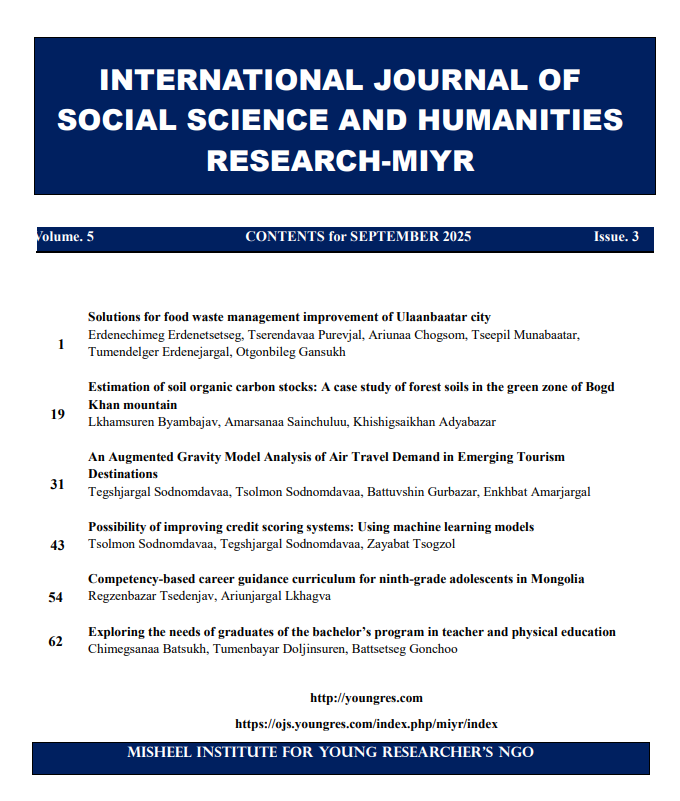
Possibility of improving credit scoring systems: Using machine learning models
DOI:
https://doi.org/10.53468/ijsshr-miyr.v5i3.10Keywords:
Machine learning, Credit risk, Credit scoring, Financial inclusion, XGBoost, Non-bank financial institution, Explainable AIAbstract
This study investigates the potential for improving credit scoring systems in non-bank financial institutions (NBFIs) by applying advanced machine learning techniques. The primary objective is to develop predictive models that more accurately assess credit risk compared to traditional statistical methods. Using real-world, anonymized loan data from a Mongolian NBFI, the study applies and compares three ensemble learning algorithms: Random Forest, XGBoost, and LightGBM. Key variables such as loan amount, repayment history, age, interest rate, and loan term were used to train and validate the models. Among the tested models, XGBoost demonstrated the highest predictive accuracy, with 93% classification performance and strong model robustness as indicated by ROC-AUC and error metrics. The findings highlight that machine learning models, particularly XGBoost, outperform conventional approaches in terms of both accuracy and practical applicability. Moreover, the integration of explainable AI techniques enhances the transparency of the credit scoring process. This research contributes to the localization of modern credit scoring tools in emerging markets and provides a scalable solution to improve financial inclusion and risk-based decision-making in NBFIs
References
Xu, T. (2024). Comparative analysis of machine learning algorithms for consumer credit risk assessment. Transactions on Computer Science and Intelligent Systems Research, 4. doi.org/10.62051/r1m3pg16
Golbayani, P., Florescu, I., & Chatterjee, R. (2020). A comparative study of forecasting corporate credit ratings using neural networks, support vector machines, and decision trees. arXiv. doi.org/10.48550/arXiv.2007.06617
Lundberg, S., & Lee, S.-I. (2017). A unified approach to interpreting model predictions. Advances in Neural Information Processing Systems, 30. doi.org/10.48550/arXiv.1705.07874
Ribeiro, M. T., Singh, S., & Guestrin, C. (2016). “Why should I trust you?” Explaining the predictions of any classifier. In Proceedings of the 22nd ACM SIGKDD International Conference on Knowledge Discovery and Data Mining, 1135–1144. doi.org/10.1145/2939672.2939778
Jagtiani, J. A., & Lemieux, C. (2019). The roles of alternative data and machine learning in fintech lending: Evidence from the LendingClub consumer platform. Financial Management, 48(4), 1009–1029. doi.org/10.1111/fima.12295
Mestiri, S. (2024). Credit scoring using machine learning and deep learning based models. Data Science in Finance and Economics, 4(2), 236–248. doi.org/10.3934/DSFE.2024009
Gambacorta, L., Huang, Y., Qiu, H., & Wang, J. (2024). How do machine learning and non-traditional data affect credit scoring? New evidence from a Chinese fintech firm. Journal of Financial Stability, 73, 101284. doi.org/10.1016/j.jfs.2024.101284
Pathipati, P., & Kumar, S. M. (2024). Credit card approval prediction using XGBoost compared with Random Forest. Risks, 12(11), 174. doi.org/10.3390/risks12110174
Capuano, F., & Vento, M. (2024). A novel profit-driven framework for model evaluation in credit scoring. Engineering Applications of Artificial Intelligence, 112, 109137. doi.org/10.1016/j.engappai.2024.109137
Valdrighi, G., Ribeiro, A. M., Pereira, J. S. B., et al. (2024). Best practices for responsible machine learning in credit scoring. arXiv. doi.org/10.48550/arXiv.2409.20536
Li, Y., Zhao, R., & Sha, M. (2024). A hybrid credit risk evaluation model based on three-way decisions and stacking ensemble approach. Computational Economics. doi.org/10.1007/s10614-024-10747-6
Zhou, Z.-H. (2025). Ensemble methods: Foundations and algorithms (2nd ed.). CRC Press. doi.org/10.1007/978-981-15-1967-3
Rotari, M., & Kulahci, M. (2023). Variable selection wrapper in presence of correlated input variables: Boruta algorithm. Quality and Reliability Engineering International. doi.org/10.1002/qre.3398
Gür, Y., Toğaçar, M., & Solak, B. (2025). Integration of CNN models and machine learning methods in credit score classification. Computational Economics. doi.org/10.1007/s10614-025-10893-5
Sodnomdavaa, T., Sodnomdavaa, T., & Amgalanbat, N. (2025). Possibility of predicting inflation: Using machine learning model. International Journal of Social Science and Humanities Research-MIYR, 5(2), 49–64. doi.org/10.53468/mifyr.2025.05.02.49
Downloads
Published
How to Cite
Issue
Section
Categories
License
Copyright (c) 2025 Tsolmon Sodnomdavaa, Tegshjargal Sodnomdavaa, Zayabat Tsogzol

This work is licensed under a Creative Commons Attribution 4.0 International License.


